Regional Diversity, Subregional Homogeneity
Part 2: 1950s – 1970s: The suburban boom and postwar roots of regional governance
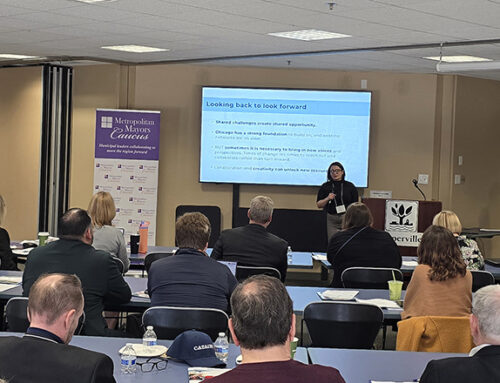
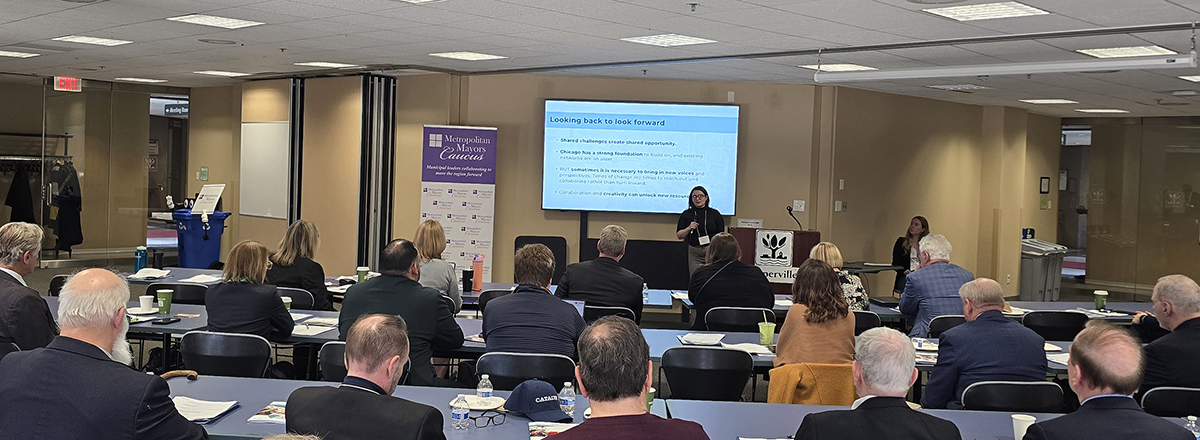
Katie Friedman, Program Manager at the Center for Equity, Effectiveness, and Efficiency (C3E), gave a presentation at our March quarterly meeting on the key moments of disruption and change in the Chicago region, examining how local leaders responded when existing governance was insufficient. Drawing on a 75-year history of metropolitan collaboration, her presentation highlighted how mayors, local leaders, and regional institutions adapted agendas, partnerships, and decision-making processes to act across boundaries when no single jurisdiction could do it alone. This blog series further delves into the topic, highlighting key lessons of each era that leaders can use when navigating change today.
CHICAGO (May 29, 2026) – In the years following World War II, the Chicago metropolitan region expanded at a rapid pace. Federal highway investments carved corridors through farmland, making it possible to live farther from the urban core and pushing development into the collar counties. Tax incentives for commercial developers to build shopping malls and office parks helped the suburbs become more economically self-sufficient rather than just bedroom communities for the city. Unfortunately, this suburban boom coincided with, and was in large part shaped by, layers of policies and practices at every level of government that distributed its benefits unequally. When the federal government created the Home Owners’ Loan Corporation (HOLC) and the Federal Housing Administration (FHA) in the mid-1930s, it institutionalized racial discrimination into the basic mechanics of homeownership. FHA underwriting standards rated neighborhoods as risky based on the racial composition of their residents, denying mortgage insurance to Black and Brown families and starving Black and Brown neighborhoods of investment in a practice that came to be known as redlining. Private lenders and real estate agents adopted the same standards, racially restrictive covenants reinforced these financial barriers at the neighborhood level, and the G.I. Bill of 1944, though it offered returning veterans low-cost mortgages to purchase homes in the booming suburbs, was administered locally in ways that largely denied Black and Brown veterans the same access as their white counterparts.
These federal programs and private real estate practices reinforced an already-existing structure of state and local laws that, as historian Tracy Steffes documented in her recent study of metropolitan Chicago, compounded the inequality further. Suburbs used state-granted zoning powers to impose minimum lot sizes and construction standards that priced out lower-income families, drew their own school district boundaries in ways that concentrated property wealth and educational opportunity within carefully defended borders, and competed aggressively for taxable wealth in a system that rewarded opportunity hoarding and left the least advantaged communities further behind.
The cumulative result was what researcher Bonnie Lindstrom later referred to as “regional diversity, subregional homogeneity”: a metropolitan area that was growing more varied and diverse in aggregate, but whose individual municipalities were becoming increasingly homogenous in terms of race and class. The differential tax bases, school quality, housing values, and economic opportunity that these overlapping policies produced shaped the fragmented and unequal landscape that local governments would spend the next several decades trying to govern.
The emergence of COGs
Curiously, this pattern of regional diversity, subregional homogeneity produced the conditions of opportunity for the emergence of early councils of governments (COGs). The transformation of the Chicago suburbs arrived with a cascade of practical problems for the region’s municipal leaders. Municipal boundaries that made sense in a slower era now cut across shared watersheds, transit corridors, and economic geographies. Growing populations needed new roads, water systems, and shared infrastructure that crossed municipal lines. And the local governments tasked with addressing these challenges were, almost by design, poorly equipped to address them alone.
The response was informal at first. Mayors and managers in geographically contiguous municipalities began convening to discuss problems that crossed their borders. Some of these conversations were little more than occasional lunches or supper clubs, while others grew into something more structured. By the late 1950s and into the 1960s, a patchwork of subregional councils of governments began to take shape across the metropolitan area, each with its own origin story and particular set of concerns.
The Northwest Municipal Conference was among the earliest, formed in 1958 when eight northwest suburbs began meeting monthly to address shared concerns like water supply, flood control, refuse disposal, and police and fire coordination. The South Suburban Mayors and Managers Association followed in 1968, its formation driven by the mounting pressures of deindustrialization and economic disinvestment hitting south suburban communities hardest. The DuPage Mayors and Managers Conference emerged around the same time, when suburban mayors recognized that the county’s partisan political machine was working against their interests and that cooperation among themselves was the most effective response. Other councils followed different paths, some forming in direct response to federal transportation planning requirements before expanding their scope to address a broader range of shared challenges.
These early COGs were not uniform in their focus, membership, or development agendas. Those representing communities hardest hit by deindustrialization and fiscal stress, like the South Suburban Mayors and Managers Association and what would become the Will County Governmental League, tended toward aggressive pro-growth positions, prioritizing infrastructure investment and job creation. Those representing more affluent and stable communities, like the DuPage Mayors and Managers Conference and the Northwest Municipal Conference, typically focused more on managed growth, intergovernmental cooperation, and the unglamorous but essential business of shared services. What all of them shared was a basic recognition that some problems were too large or too geographically diffuse for any single municipality to address on its own. They were, in other words, learning the first lesson of regional governance: that the boundaries drawn on a map are not the same as the boundaries of the problems that governments are asked to solve.
Federal funding incentivizes regional planning
The COGs might have remained informal indefinitely had the federal government not intervened through the gradual accumulation of funding requirements that made regional coordination necessary.
The first significant catalyst was the Chicago Area Transportation Study (CATS), established in 1955 as an ad hoc partnership between the City of Chicago, Cook County, the State of Illinois, and the federal Bureau of Public Roads. For its first several years, CATS functioned primarily as a research project, staffed by planners and analysts to model travel patterns and project the infrastructure needs of a rapidly expanding metropolitan area. In 1962, the federal government required metropolitan areas to have a long-range comprehensive planning process involving local elected officials to receive transportation funding. As a result, CATS was transformed from a temporary study group into a permanent planning agency with a mandate to engage the region’s municipalities in long-range transportation planning. By 1965, the original CATS transportation plan was adopted by the City of Chicago, 123 suburban municipalities, and all of the region’s COGs. While the process was not particularly visionary by today’s standards, it established a precedent for region-wide agreement on a shared planning framework as well a set of institutional relationships between the COGs, between the COGs and the city, and between local governments and state and federal agencies.
A second regional institution emerged during this same period, through a different route. The Northeastern Illinois Planning Commission (NIPC) was created by the Illinois state legislature in 1957, the product of sustained advocacy by a network of professional civic organizations based in the City of Chicago. The most influential of these was the Metropolitan Housing and Planning Council (MHPC, now the Metropolitan Planning Council, or MPC), which helped design the agency’s governmental structure in collaboration with allies in the Illinois legislature. From its inception, NIPC’s executive body consisted of local government representatives from Chicago, Cook County, and the collar counties, who oversaw a professional planning staff.
Unlike CATS, NIPC focused on land use rather than transportation. It possessed no regulatory or taxing power and instead functioned primarily as an advisory body, producing plans, providing technical assistance to municipalities, and supporting federal funding applications. From the start, NIPC understood that its influence would have to come from establishing itself as an intellectual and technical authority rather than a governing one. Throughout the 1960s, it worked actively to spread planning capacity throughout the region and provided the emerging COGs with the technical resources and institutional connections they needed to develop more sophisticated agendas. In this way, NIPC played a quiet but important role in formalizing what had begun as informal networks of suburban mayors into more structured and capable subregional institutions.
Under President Johnson’s Great Society programs in the 1960s, NIPC led substantive regional efforts on water infrastructure, sanitation, and environmental conservation, leveraging federal funding to accomplish initiatives that individual municipalities could not accomplish alone. But it also carried a structural vulnerability that traced back to its origins. The MHPC, for all its organizational sophistication, was rooted in the professional class of Chicago’s affluent northern suburbs, a civic culture that supported regional equality in the abstract but had limited familiarity with the actual conditions facing Black and Brown communities and working-class municipalities across the region. NIPC inherited this narrow civic base, and it made the agency poorly positioned to build the broader legitimacy it needed to weather political and fiscal turbulence.
As the optimism of the Great Society era gave way to a more constrained political and fiscal environment in the 1970s, NIPC’s influence waned. Federal retrenchment reduced the flow of resources that had made ambitious regional initiatives possible. Deindustrialization, the decline of manufacturing employment, and the growing fiscal stress of older inner-ring suburbs gradually transformed Chicago’s regional economy, making the disparities between communities more acute even as the political appetite for regional solutions diminished.
Amidst these changes, NIPC’s advocacy for “bottom-up regionalism” was challenged by a conservative turn in suburban politics. NIPC embraced and advocated for the home rule provisions of the 1970 Illinois Constitution, believing that municipalities with greater autonomy would be more willing partners in voluntary regional coordination. While a defensible position during a period of political alignment and abundant resources, it also meant that when municipalities chose not to cooperate, NIPC had limited tools to respond. When it attempted to use its federal grant review powers in the late 1970s to challenge exclusionary zoning practices in the western suburbs, the backlash from suburban mayors was swift and fierce, exposing the fragility of a regional planning model built solely on persuasion and influence.
Looking Ahead
By the mid-1980s, the Chicago metropolitan region had been through 30 years of growth, fragmentation, federal investment, and fiscal retrenchment. CATS continued to function, its survival guaranteed by the federal transportation funding that kept it institutionally necessary, though it remained in practice more an instrument of state government than a genuine vehicle for regional cooperation. NIPC, which had come closer to building something like a regional planning culture, lost its footing when the federal money it depended on contracted and its narrow civic base left it without the allies it needed to adapt. What this era produced, in retrospect, was a period of consolidation rather than expansion. The COGs became more professionally staffed and more institutionally coherent. Their relationships with state and federal agencies, facilitated by NIPC and CATS, became more sophisticated. And the local leaders who participated in them, some of whom would go on to play significant roles in the regional governance arrangements of the 1990s, developed a working knowledge of the mechanics of intergovernmental cooperation that would prove valuable when the conditions for more ambitious collaboration eventually returned.
About The Author
The series draws on two years of research by Katie Friedman, whose study of collaborative governance in the Chicago metropolitan region, recently published in 2025 in the journal Urban Governance, traced 75 years of regional institution-building across three distinct historical periods. Katie is currently a Program Manager with the Center for Equity, Effectiveness and Efficiency (C3E) and brings nearly a decade of experience working with local governments in the Chicago region.
Sources:
Planey, D. (2023). Regional planning and institutional norms in the United States: Civic society, Regional planning, and City-region building in the Chicago Metropolitan region. Journal of Planning Education and Research, 43(4), 958–969. 10.1177/0739456X20937346.
Lindstrom, B. (1997). Regional cooperation and sustainable growth: A study of nine councils of government in the northeastern Illinois region. Great Cities Institute.
Steffes, T. L. (2024). Structuring inequality: How schooling, housing, and tax policies shaped metropolitan development and education. University of Chicago Press.
Blog Series:
If you missed Part 1 of the Governing Through Change blog series, read it here: