What Chicago’s Metropolitan History Teaches Us About Leadership and Collaboration
Part 1: Looking Back to Look Forward
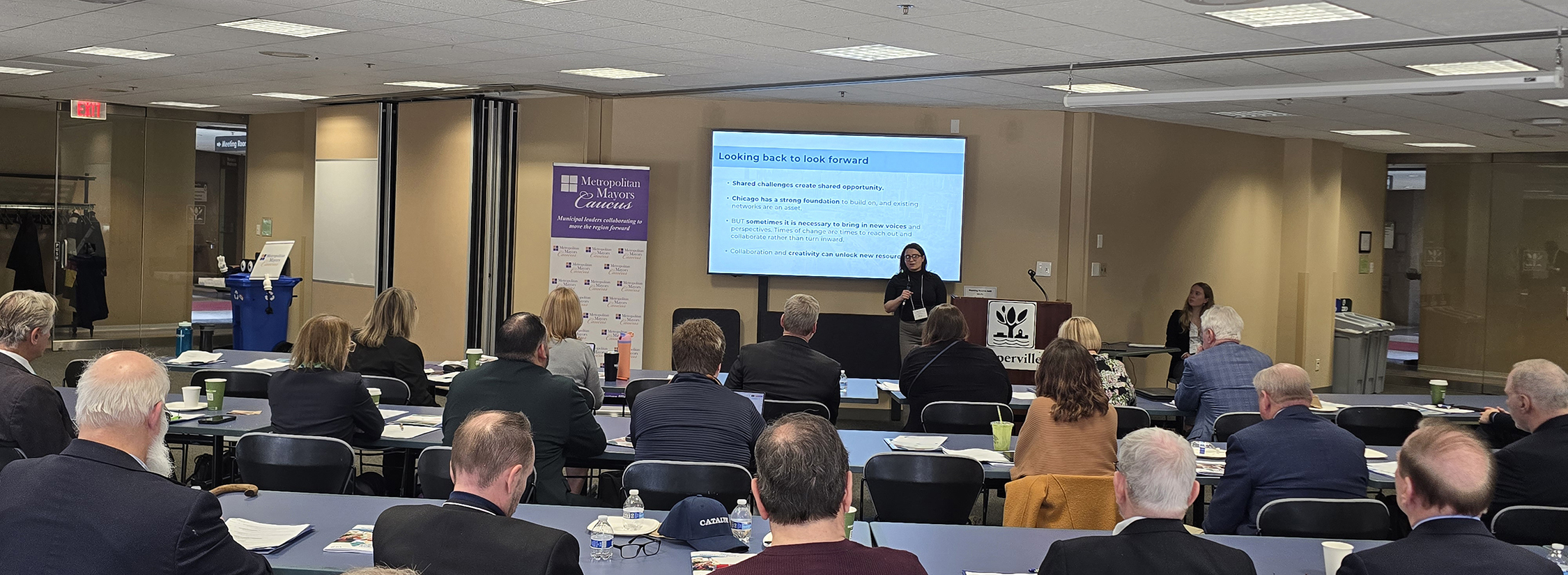
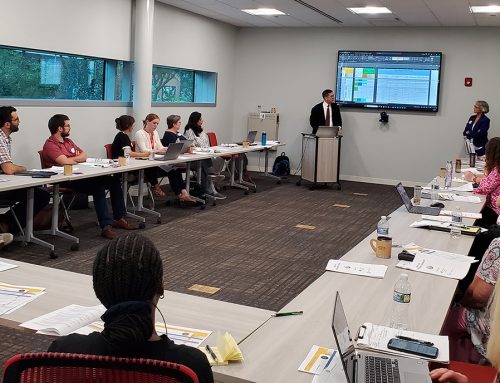
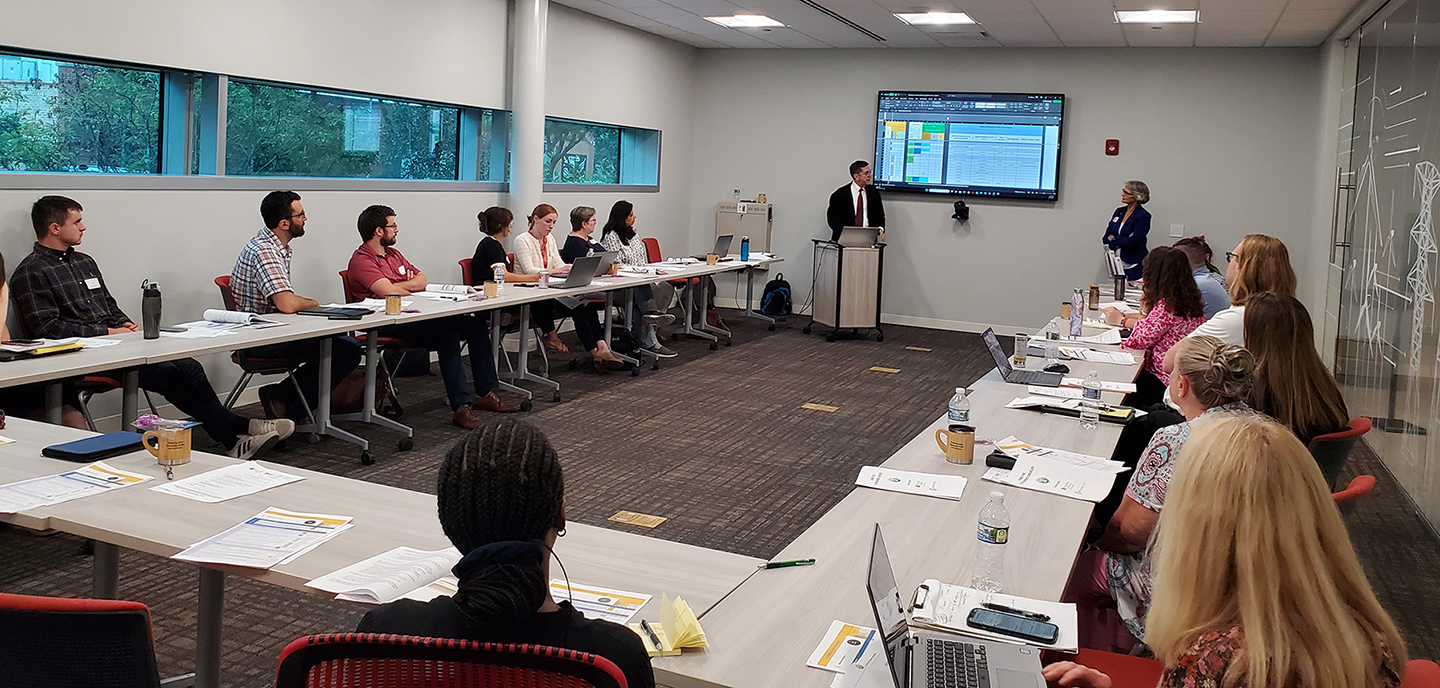
Katie Friedman, former Caucus staffer and current program manager at the Center for Equity, Effectiveness, and Efficiency (C3E) speaks at the March quarterly meeting on collaborative governance in the Chicago region over time.
Katie Friedman, Program Manager at the Center for Equity, Effectiveness, and Efficiency (C3E), gave a presentation at our March quarterly meeting, at some of the COGs, and at the Chicago Metropolitan Agency for Planning on the key moments of disruption and change in the Chicago region, examining how local leaders responded when existing governance was insufficient. Drawing on a 75-year history of metropolitan collaboration, her presentation highlighted how mayors, local leaders, and regional institutions adapted agendas, partnerships, and decision-making processes to act across boundaries when no single jurisdiction could do it alone. This blog series further delves into the topic, highlighting key lessons of each era that leaders can use when navigating change today.
CHICAGO (April 27, 2026) – If you were looking for a metropolitan region with a long and durable history of collaborative governance, the Chicago area would not be the obvious place to start.
The Chicago region is, by most measures, the most administratively fragmented metropolitan area in the United States. Roughly 1,440 independent units of local government operate and overlap within a geographic area smaller than the state of Connecticut. The State of Illinois also grants its municipalities more autonomy than any other state in the country, meaning those units often have little to no legal obligation to coordinate with each other at all, and in some cases are even incentivized to compete. Layered on top of this complex institutional web is a deep legacy of racial and economic stratification — the product of decades of deliberate policy choices around housing, schools, and infrastructure — that produced unequal tax bases, service levels, and opportunities across the region’s communities. This combination of institutional fragmentation, jurisdictional autonomy, and socioeconomic divisions have made the Chicago region, for most of its history, a place where regional cooperation seemed not just difficult, but structurally improbable.
And yet.
Over the past 75 years, leaders in the Chicago metropolitan region have repeatedly found ways to work across these divisions. They have developed institutions that outlasted the leaders who founded them, navigated dramatic shifts in federal funding and state politics, and in recent years, forged a coordinated regional response to climate change that attracted national and international attention. None of this was inevitable; it happened because, at critical moments, the region’s leaders made the choice to reach beyond their own borders.
This series draws on a longitudinal study of collaborative governance in the Chicago metropolitan region from the 1950s through 2025, conducted through a combination of archival research, analysis of regional planning documents, and in-depth interviews with nineteen individuals who have shaped regional governance over the past several decades: long-time mayors, executive directors of leading regional organizations, civic leaders, academics, and planners.
The research reveals a story of three distinct but interrelated eras in our region’s history, each shaped by its own political and economic pressures, each producing a different kind of collaborative response. The regional institutions we know and love today — the Metropolitan Mayors Caucus, the Chicago Metropolitan Agency for Planning, the network of subregional Councils of Government — are the product of these eras, built, piece by piece, by leaders who believed we are stronger when we work together.
Today, our region’s leaders are once again tasked with responding to circumstances they did not design and cannot fully control. The question this series tries to answer is: what can we learn from looking back, and how will we move forward together?
“I think we have evolved as a region to understand that, in order to succeed, those belonging to this shared metropolitan-defined space have to participate in the discussions, the deliberations and the decision-making to ensure that not only are our local governing boards and governing bodies moving in a direction, but ideally we’re all moving in the same direction as a region… Whether that be sustainability efforts, transportation, housing, economic development, you name it. We have always prided ourselves on our fidelity to our local communities, but we’ve also grown to accept and recognize the fact that it’s a sincere and real fact that we can’t do this in isolation. Particularly in Chicago, when we think about the success of our region, we understand that all of us must participate in that success. When one community struggles, we all tend to struggle. And vice versa, when communities succeed, we all tend to succeed.”
Mayor Kevin Burns, City of Geneva.
About This Blog Series
Governing Through Change is a collaboration between the Metropolitan Mayors Caucus and the Center for Equity, Effectiveness, and Efficiency (C3E). The partnership behind this series reflects a shared conviction: that understanding how regional collaboration has worked in the past is essential to making it work better in the future. The Metropolitan Mayors Caucus has been at the center of that story for nearly three decades, convening the region’s 275 municipalities, building consensus across difference, and forging coordinated responses to some of the most complex challenges facing metropolitan Chicago. C3E brings a complementary lens, grounded in the belief that lasting change in public institutions requires more than awareness: it requires a clear roadmap, grounded in evidence, for the kind of organizational transformation that makes equitable and effective governance possible.
Together, we see this series as more than a history. The Chicago region’s experience offers lessons to practitioners working in fragmented regions everywhere: a window into the conditions that make regional collaboration possible, and the choices that shape whether regions rise to their challenges or remain stuck in the boundaries that divide them.
Over the next five posts, we will move through the three historical periods of Chicago’s regional governance story, drawing out the lessons of each era before pulling them together into a practical framework for leaders navigating fragmentation and change today. The goal is to put that knowledge in the hands of the people who need it most: the mayors, managers, planners, directors, and civic leaders who are doing this work right now, in their own communities, and who deserve to know that the ground they are standing on has a longer and more instructive history than it might appear.
About The Author
The series draws on two years of research by Katie Friedman, whose study of collaborative governance in the Chicago metropolitan region, recently published in 2025 in the journal Urban Governance, traced 75 years of regional institution-building across three distinct historical periods. Katie is currently a Program Manager with the Center for Equity, Effectiveness and Efficiency and brings nearly a decade of experience working with local governments in the Chicago region.