
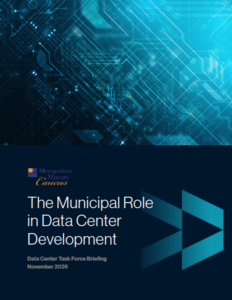
 CHICAGO (Nov. 18, 2026) — The Caucus released a briefing about its Data Center Task Force’s work, in time for the Illinois General Assembly Veto Session when lawmakers are discussing the POWER Act. This briefing highlights the task force’s key findings, drawing on municipal experiences to identify existing local oversight practices and issues that may require state or regional attention.
In fall 2025, Caucus Environment and Energy Committee Chair Kevin Burns, City of Geneva Mayor, called for the formation of the Data Center Task Force and served as its Chair.
“The Caucus has the unique ability to convene subject matter experts and municipal officials to share information and experiences to inform important decisions about data center developments in our communities,” Burns said. “We are proud to avail local, regional and state officials in Illinois the results of our efforts.”
The Caucus convened Data Center Task Force meetings to examine how municipalities regulate data centers, to share local experiences and to identify challenges communities face in overseeing these facilities. Data Center Task Force met 10 times over five months, and members toured three data centers in the region. The Caucus also surveyed municipalities about their data center regulations and oversight practices. The task force wrapped up earlier this year.
Some of the key takeaways from the task force’s work are listed below and in the briefing.
Data Center Task Force’s Key Takeaways
- Data centers aren’t always the biggest water users in a community, but some consume substantial amounts. Although some data centers use less water than other commercial businesses, water consumption varies considerably depending on the cooling technology used. Municipal officials should examine each facility’s projected water use in the context of local supplies, infrastructure capacity and competing demands.
- The noise impact associated with data centers depends heavily on where they are located. Data centers may be well suited to established industrial areas, where equipment noise is less likely to disturb residents. However, facilities near homes can create significant concerns, particularly because cooling equipment operates continuously and backup generators operate periodically. Municipal officials should consider location, setbacks, noise studies and enforceable mitigation measures and operating standards when reviewing proposals.
- Municipalities have more bargaining power with data center developers than they once did. While municipalities once competed to attract data center investment, developers are now racing to secure suitable locations amid intensifying competition for available sites. Municipal officials may be able to negotiate infrastructure improvements, financial contributions and other community benefits, but they should carefully assess long-term costs and obligations before approving agreements.
- Municipalities report significant economic benefits from data center development. Municipal officials have seen substantial increases in tax revenue and other financial benefits from data centers. While these facilities can provide a major source of revenue for municipalities and other local taxing bodies, officials should also consider infrastructure costs, impacts on municipal utilities and long-term financial obligations when evaluating proposals.
- Municipalities need practical ways to enforce operating requirements after facilities open. Officials should consider how to monitor noise and water use, investigate complaints and ensure operators comply with established conditions over time.
- State lawmakers should recognize what municipalities already regulate and where their authority is limited. Municipal officials already use zoning, permitting and development agreements to regulate water use, noise and other local impacts and negotiate appropriate community benefits. State lawmakers should avoid duplicating or conflicting with these requirements and focus on issues beyond municipal control, especially regional grid impacts and air emissions from backup diesel generators. Additional state oversight of generator emissions and noise pollution may be warranted to address concerns that municipalities cannot fully resolve through local regulations.
- Electricity capacity and costs require attention beyond the municipal level. Municipalities have limited control over the regional electricity supply and distribution, yet increased energy demand associated with data centers pose a serious threat to energy reliability, sustainability, and affordability. Regulators must ensure adequate and equitable energy access for all customers.

Members of the Data Center Task Force view the sound barrier at CyrusOne CHI2 data center in Aurora. The Caucus’ Data Center Task Force briefing features four case studies about municipal experiences with data center developments, including Aurora’s experience.
The briefing also includes four case studies about municipal experiences with data center developments in Aurora, DeKalb, Northlake, and Yorkville. The communities featured in the case studies participated in the Caucus’ Data Center Task Force. Additionally, the task force members viewed data centers in three of the four communities (Aurora, DeKalb, and Northlake) during a tour in March.
The task force’s discussions and the case studies in this briefing highlight the importance of local governments evaluating data center proposals in the context of each community’s needs, resources and existing regulations. Municipal officials have considerable authority to address local impacts, but some concerns, particularly regional electricity costs, require action beyond the municipal level.
The Caucus will release a full report in December 2026, with additional findings and recommendations.
About the Metropolitan Mayors Caucus
The Metropolitan Mayors Caucus is a membership organization of the Chicago region’s 275 cities, towns and villages. Founded in 1997, the Caucus pushes past geographical boundaries and local interests to work on public policy issues. The organization provides a forum for metropolitan Chicago’s chief elected officials to collaborate on common problems and work toward a common goal of improving the quality of life for the millions of people who call the region home. For more information, visit our homepage at mayorscaucus.org, and connect with us on Facebook, LinkedIn, Instagram, X, and YouTube.