
Housing Rehabilitation Initiatives
Park Forest
Cook and Will Counties
The Village of Park Forest has leveraged strategic planning, state and non-profit partnerships, and reinvested funds to reduce vacancy, restore distressed properties, and stabilize neighborhoods impacted by the foreclosure crisis.
Background
Park Forest, like much of Chicagoland’s south suburbs, was disproportionately impacted by the housing crisis that followed the 2008 recession. According to the community’s own figures, by 2014 there were 587 vacant homes in the Village, more than 300 of which were in foreclosure, with the average home value sinking to $39,850.
In response, Park Forest has made a sustained effort to address housing vacancy, abandonment, and blight. Since 2009, the Village has obtained $1,769,045 in County, State and IHDA funds to demolish 95 single-family homes that were beyond repair. The Village converted vacant lots within various neighborhoods to community gardens and created a small neighborhood playground within the Eastgate neighborhood, the area within Park Forest hit hardest by foreclosures. The Village also worked closely with residents through planning efforts such as its 2012 Homes for a Changing Region plan and the 2018 Comprehensive Housing Plan. Building on this foundation, Park Forest has launched a series of innovative partnerships and programs aimed at rehabilitating and restoring homes across the community.
South Suburban Trades Initiative
In 2018, the Village of Park Forest, in partnership with Prairie State College and South Suburban College, launched the South Suburban Construction Trades Initiative (SSTI). The program rehabilitates formerly abandoned, Village-owned houses while providing hands-on construction experience to students in the colleges’ construction and HVAC programs, as well as apprentices from apprenticeship programs like Harmony International, Plumbers Local 130, Electricians Local 130, and Painters District Council No. 14.
The initiative began that same year with the rehabilitation of a single home. Grant funding from the Illinois Housing Development Authority’s (IHDA) Abandoned Properties Program covered exterior, code-required repairs, while $69,600 from the Village’s Economic Development Capital Projects budget paid for rehabilitation and project management costs. Additional expenses included legal fees for acquiring and selling the property, as well as maintenance costs prior to renovation. When the home sold for $110,000 in December 2020, the net proceeds were placed in a restricted fund to support future housing and SSTI projects, ensuring resources would be available if rehabilitation costs ever exceeded sale prices, Village funds, and eligible grants.
The Village then repeated this process in subsequent years. Grant funding – first from IHDA’s Abandoned Properties Program and later from its Strong Communities Program Round 1 and Round 2 – was consistently used for exterior work and materials, while Village funds covered interior rehabilitation and project management. In several cases, Prairie State College, South Suburban College, and local unions provided most of the labor, keeping expenses mostly limited to materials.
Rehabilitation work has included roof replacements, garage repairs, electrical upgrades, plumbing, HVAC installation, interior wall reconstruction, window replacements, sheetrock installation, and exterior improvements. The last four projects were complete gut rehabs that resulted in the best option for a homeowner outside of new construction. For students, the program offers valuable real-world training that supports their progress toward certificates in building rehabilitation and new construction.
For the neighborhood, it supports strong property values and turns a once vacant, abandoned, or deteriorated property into a neighborhood connection. The Village consistently receives positive feedback from these projects and finds that putting resources into these properties almost immediately leads to independent projects at nearby properties.
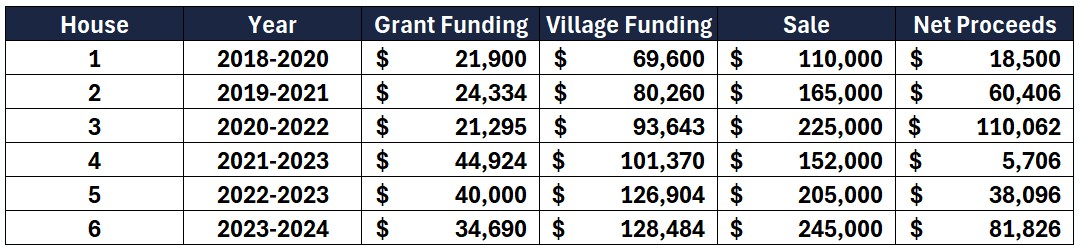
South Suburban Trades Initiative Homes
Goal
To reinvest in the community’s existing housing stock, stabilize neighborhoods impacted by foreclosures, and restore confidence in the housing market.
Target
Single-family homes in Park Forest, with an emphasis on homes in neighborhoods hit hardest by foreclosures and lack of investment.
Financing
Illinois Housing Development Authority (IHDA) funding, Cook County and State resources, Village capital funds, and reinvested program proceeds. Partnerships with Prairie State College, South Suburban College, labor unions, Rebuilding Together Metro Chicago, and the South Suburban Land Bank further stretch limited resources.
Success
The Village systematically reduced vacancy, addressed blight, improved housing quality, and returned distressed properties to productive use. These efforts helped Park Forest recover from the 2008 recession and restore community-wide Equalized Assessed Value to pre-recession levels.
Lessons Learned
Long-term planning documents are most effective when they are treated as living frameworks that can be revisited and adapted over time rather than static reports. Partnerships are essential to scaling impact and overcoming financial, staffing, and technical constraints. Reinvestment strategies that recycle proceeds and focus on quality outcomes – rather than volume alone – help maintain community trust and long-term program viability. Sustained public involvement across multiple plans has ensured that housing initiatives remain aligned with resident priorities.
Home Repair and Accessibility Program
In December 2022, the Village of Park Forest was awarded $400,000 from IHDA through the Home Repair and Accessibility Program (HRAP). The project focused primarily on roof repairs and roof replacements. Implementation involved several steps:
- Marketing the program to residents.
- Pre-screening and selecting eligible applicants.
- Conducting property inspections to verify the need for repairs.
- Obtaining and evaluating contractor bids.
- Submitting pre-approval packages to IHDA for review.
- Once approvals were secured, construction work began.
Due to the positive progress by the Village, the Village was awarded an additional $300,000 in grant funding to support primarily roof repairs and roof replacements. The program’s outcomes included three full home rehabilitations and 20 roof repairs or complete roof replacements. Residents shared that the program addressed critical needs that would not have been met without HRAP funding and helped prevent further deterioration that would have resulted from deferred maintenance.
In June 2025, the Village of Park Forest was awarded $600,000 by the Illinois Housing Development Authority to administer HRAP Round 2, which includes some changes to the program. Among the most important are higher maximum awards for the three different project types. The Village of Park Forest has partnered with Rebuilding Together Metro Chicago as its Third-Party Administrator to better leverage capabilities between each organization.
South Suburban Land Bank
In 2012, the Village of Park Forest was one of the founding members and provided seed money for the South Suburban Land Bank. The land bank works with nearly 30 partner communities in the South Suburbs. Since 2012, the land bank has revitalized almost 200 distressed properties in the South Suburbs.
In 2022, the Village of Park Forest entered into another intergovernmental agreement (IGA) with the South Suburban Land Bank (SSLB), enabling the SSLB to acquire abandoned homes, clear them of back taxes, and prepare them for sale and productive reuse. Through this partnership, the SSLB has taken ownership of more than 83 abandoned properties within Park Forest, returning them to the market and helping to reduce neighborhood blight. In 2025, due to staffing constraints in the Building Department at the Village of Park Forest, the Village updated the IGA with SSLB to allow the SSLB to complete their inspections on behalf of the Village.
In 2023, new SSLB staff started a program that the land bank would utilize IHDA grants to support the rehabilitation of homes they acquired in order to improve the housing stock in their member communities. The first such project was completed in Park Forest at 345 Miami St. This home was acquired by the SSLB in February 2024, rehabbed, and sold in June 2025 for $174,000.
Public Involvement
Housing initiatives like the three highlighted above were a part of comprehensive and housing plans that are continually refined based on residents’ input. Since the 2008 Strategic Plan for Land Use and Economic Development, subsequent reports, studies, and plans related to housing in Park Forest have guided the development of initiatives that are in tune with the community. Since 2002, the following documents have included public participation to steer their visions, goals, and objectives:
- 2002 DownTown Master Plan
- 2007 211th St Metra Station Transit-Oriented Development Study
- 2008 Strategic Plan for Land Use and Economic Development
- 2012 Sustainability Plan
- 2012 211th St Metra Station TOD Implementation Study
- 2012 Homes for a Changing Region
- 2018 Comprehensive Housing Plan
- 2019 Climate Action and Resilience Plan
- 2022 Elevating Aging-in-Community in Park Forest
- 2023 DownTown Master Plan
Contact Information
Village of Park Forest Department of Economic Development and Planning, www.villageofparkforest.com
This case study was last updated in February 2026.
See More Case Studies
Homegrown is a collection of housing best practices implemented by local governments across the seven-county Chicago region. Each case study covers a housing policy, development, or program; how it works; why it was successful; and how it was funded. To see the full collection of case studies, click on the Homegrown logo.