
Housing Opportunities for Women
Evanston
Cook County
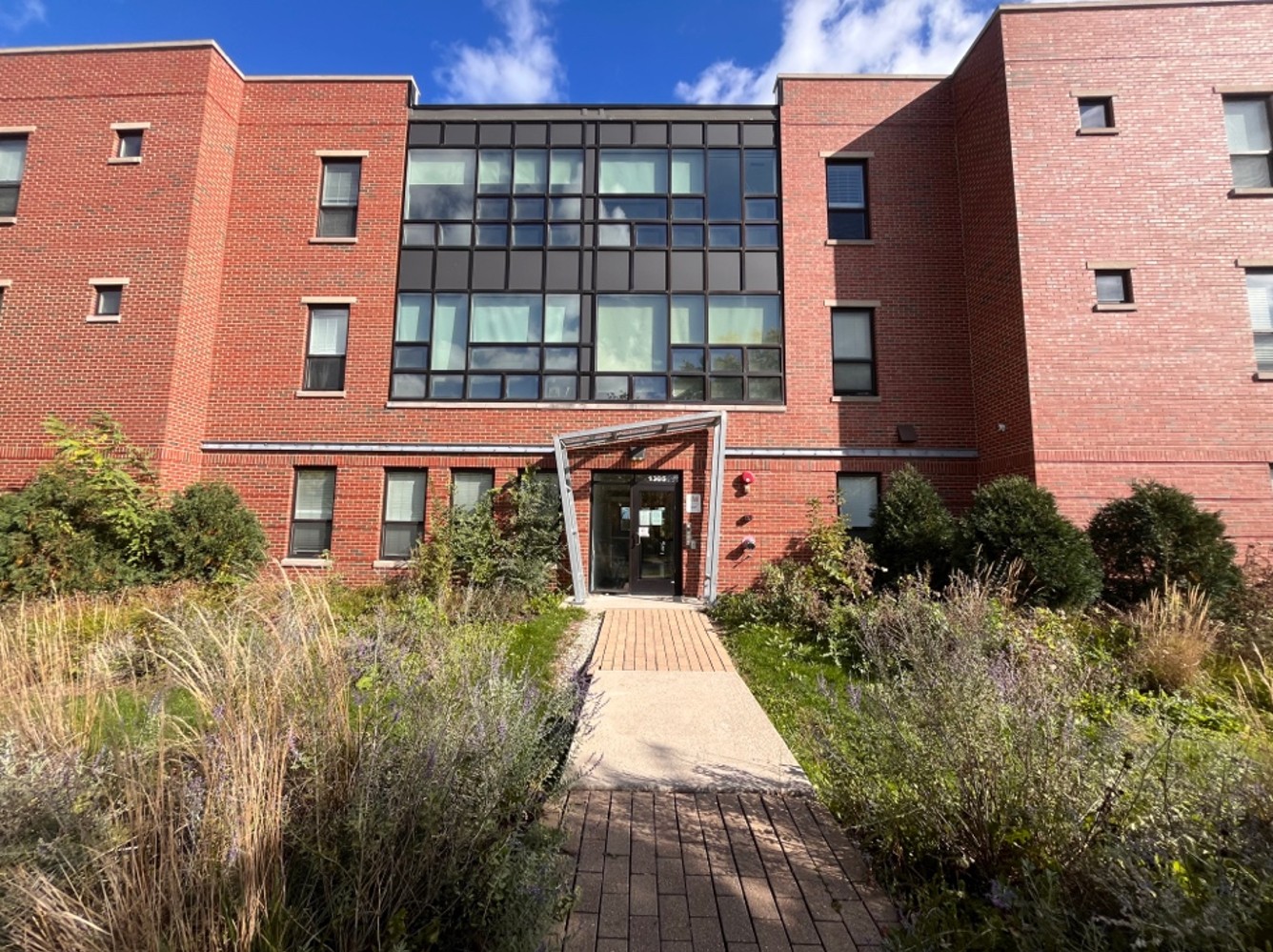
Photo courtesy of Colin Goss
The Development
Developed by Housing Opportunities for Women, a non-profit leader in permanent solutions to homelessness in Chicagoland since 1983, HOW Evanston was the organization’s first foray into development and efforts to deconcentrate poverty in Chicagoland. Formerly the site of a single-family home and a vacant lot located in an Evanston neighborhood with no designated affordable rental housing, the 20,000 square foot site was identified by HOW as having significant potential benefit as the site of an affordable multifamily apartment building. As both parcels were zoned R-5, which permits three-story apartment buildings, the proposed development was already permitted by right under Evanston’s zoning code and was able to avoid the often contentious and lengthy rezoning application process. Still, in the several meetings that took public comment regarding the proposal, vocal opposition from neighbors contested that the density of the building didn’t blend with the single-family nature of the neighborhood, that parking and sewage would be pushed over capacity, and that the development should be built in a more affluent area of Evanston. These concerns were considered by others in the community as less pressing than the need for affordable housing in Evanston and argued that although the neighborhood offers many affordable homeownership opportunities, no affordable rental options existed. The project was ultimately supported by much of the City Council and planning staff as being in line with the goals of the City’s consolidated plan.
Though the development did not require City council approval, HOW did request $550,000 from Evanston’s affordable housing funds and was rejected 3-5 by City Council. Significant funding was secured, allowing the building to proceed with a modified budget, thanks to the State’s Permanent Supportive Housing Program, donation tax credits through the Illinois Affordable Housing Tax Credits, and operating subsidies via Project Based Vouchers (PBVs) from the Regional Housing Initiative (RHI). All apartments in the building were subsidized so that residents only pay 30% of their income, with 12 receiving vouchers through Project-Based Vouchers (PBVs) issued by the Chicago Housing Authority (CHA). Initially, this development received these PBVs through the Regional Housing Initiative (RHI) and were always intended to be administered by the CHA, which itself would not have allocated PBVs for families in Evanston were it not for RHI. After roughly a year of pre-development, ground was broken in 2018 and doors opened in 2019.
The general contractor was Chicago-based real estate developer Urban Innovations, who has had a long-standing relationship with HOW, and SHED Studio served as the architectural firm. The final product went through numerous changes to respond to community concerns, including the provision of a stormwater detention system with a permeable pavement parking lot and native landscaping. Ultimately, the beautiful 3-story, 16-unit building design – including two ADA-accessible apartments –was applauded by supporters and opponents alike. Building amenities include community spaces on each floor, first-floor storage units, laundry facilities, a 16-space parking lot, and on-site support services offering case management and youth programming. In addition to the two Pace bus stops on either corner of the block, residents are also within walking distance to Evanston Plaza (which includes a large grocery store), Skokie Northshore Sculptural Park and the Northshore Channel Trail, Evanston Township High School, a local swim program, and Martin Luther King Jr. Literary and Fine Arts (K-8) School.
Now up and running for more than five years, this building and its tenants offer stability and vitality to the neighborhood. The development demonstrates that experts in the field of affordable housing are innovating creative solutions to finance the development of desperately needed affordable living options for families in high opportunity areas like Evanston that have access to good schools, jobs, transit, parks and other robust amenities.
Goal
To create safe and stable affordable housing for families at risk of homelessness and/or being priced out of Evanston.
Target
Families earning between 30% and 50% of the Area Median Income (AMI) referred to the building either through the Regional Housing Initiative (RHI) waitlist or the Statewide Referral Network (SRN), with preferences for people who may have lived or worked near the development that were already on the RHI or SRN waitlists.
Financing
With a total project budget of roughly $5.5 million, financing was secured from the Illinois Housing Development Authority Permanent Supportive Housing Program and the Corporation for Supportive Housing, as well as resources from the Federal Home Loan Bank and a ComEd energy efficiency grant. Critical private contributions from Howard Conant and Dennis and Martha Pierce also helped leverage about $500,000 in state donation tax credits for this development.
Success
In Chicagoland, where limited housing options exist in high-opportunity suburbs for low-income households who rely on housing subsidies, HOW Evanston’s 16 apartments have helped fill a crucial gap and fractured a long-standing barrier in the housing landscape. No City zoning variances nor funding were ultimately needed for this development – only an approval from the City’s Design Review Committee.
Lessons Learned
While local communities typically prefer local preferences, these appetites also need to be balanced with fair housing laws and regional, state, and federal funding priorities. For this building, without City funding, it was difficult to implement a strong local preference beyond RHI’s standard prioritization on its own wait lists.
While the most significant resource available for affordable rental housing is the federal Low-Income Housing Tax Credit (LIHTC) program, HOW was able to secure funding for at-risk families through the State’s Permanent Supportive Housing Program.
Contact Information
City of Evanston Community Development Department, www.cityofevanston.org
This case study was last updated in February 2026.
See More Case Studies
Home Grown is a collection of housing best practices implemented by local governments across the seven-county Chicago region. Each case study covers a housing policy, development, or program; how it works; why it was successful; and how it was funded. To see the full collection of case studies, click on the Home Grown logo.