
The Metropolitan Mayors Caucus and Opticos Design have developed a Missing Middle Housing Toolkit for the Chicago region.
Defined as house-scale buildings that contain multiple residential units and are located in walkable neighborhoods, Missing Middle Housing has a unique ability to offer attainable homeownership and meet the housing needs of growing demographics such as seniors and smaller households.
Culminating a year of trainings and discussions with a peer network of elected officials, commissioners, and staff from 18 municipalities, the toolkit highlights proven strategies, relevant case studies, and actionable next steps for municipalities. The toolkit is designed to be relevant for communities of any size, location, and housing market.
Municipal leaders can use the toolkit to craft tailored, innovative approaches to address their communities’ housing needs. The toolkit can be used to:
- Educate elected officials, commissioners, and residents on Missing Middle Housing and its benefits.
- Engage realtors and developers to understand their interest in these housing types.
- Guide planning efforts that identify priority areas within a community and which types of Missing Middle Housing make sense for different contexts.
- Tailor local zoning and regulations to achieve desired outcomes.
- Implement strategies to encourage Missing Missing Housing such as a pilot project, pre-approved plans, or request-for-proposals.
To download the full-size file, click here. For a reduced file size suitable for email, click here.
This toolkit was made possible thanks to the support of the Richard H. Driehaus Foundation, the expertise of Opticos Design, and the thoughtful input of municipal leaders that made up the peer network throughout this process.
The toolkit is the result of several years of collaboration:
- In 2021, the Housing and Community Development Committee identified “attraction of new Missing Middle Housing” as a top need for assistance.
- In December of 2022, the Committee’s quarterly meeting focused on Missing Middle Housing.
- In the spring of 2023, a working group was formed to identify barriers to Missing Middle Housing and further specify what technical assistance was needed.
- In the spring of 2024, the Richard H. Driehaus Foundation provided support for technical assistance to address the needs that were identified.
- A group of 18 municipalities then applied for assistance and participated in the “Missing Middle Housing Peer Network” over the course of one year.
Peer Network Education: Opticos Design led a series of six training meetings attended by municipal staff, commissioners, and elected officials. Over 30 participants attended each meeting, with 18 jurisdictions represented. Meeting topics, selected in response to needs identified by the peer network, focused on the following:
- Understanding how Missing Middle Housing applies to your community;
- Zoning and policy regulations to encourage quality design;
- Building community understanding and support;
- Case studies in implementing middle housing;
- Regulatory and financial tools to increase development feasibility and attainability; and
- Overview and feedback on the draft Missing Middle Housing Toolkit.
Test Fits: Using real-world sites suggested by peer network municipalities, Opticos Design created three “test fits” that visualize middle housing, compare these designs to current regulations, and identify which changes to existing regulations would enable more housing types. Over 40 sites were suggested by 18 peer network municipalities. After carefully selecting three sites that would be applicable for as broad of a range of communities as possible, Opticos Design drafted each test fit and incorporated feedback from the peer network and focus group input from developers.
Site Study Workshop: After a year of meeting virtually, a workshop brought peer network participants together in person to explore various Missing Middle Housing concepts. This hands-on, interactive exercise allowed participants to test out different missing middle housing types on common lot sizes to understand site planning best practices and the role zoning regulations can play in enabling well-designed missing middle housing.
Toolkit: Culminating the process, the Missing Middle Housing Toolkit documents the insights gained at each stage and provides a menu of actionable next steps that municipalities – whether part of the peer network communities or not – can take to expand housing options in their communities. Each chapter draws on input from peer network training meetings and provides guidance tailored to the most common questions raised by participants.
Missing Middle Housing refers to house-scale buildings that contain multiple units and are located in walkable neighborhoods. They are compatible in form and scale with typical single-family homes and are an effective strategy for “gentle infill” within existing residential neighborhoods.
Missing Middle Housing is “middle” in two ways. First and foremost, the term “middle” refers to the house- scale form and size that is compatible in width, depth, and height to a typical detached house. Second, “middle” refers to housing that is more attainable and able to deliver housing for middle-income families.
They are called “missing” because very few of these housing types have been built since the early 1940s due to regulatory constraints, the shift to auto-dependent patterns of development, and the incentivization of single-unit homeownership by the federal government.
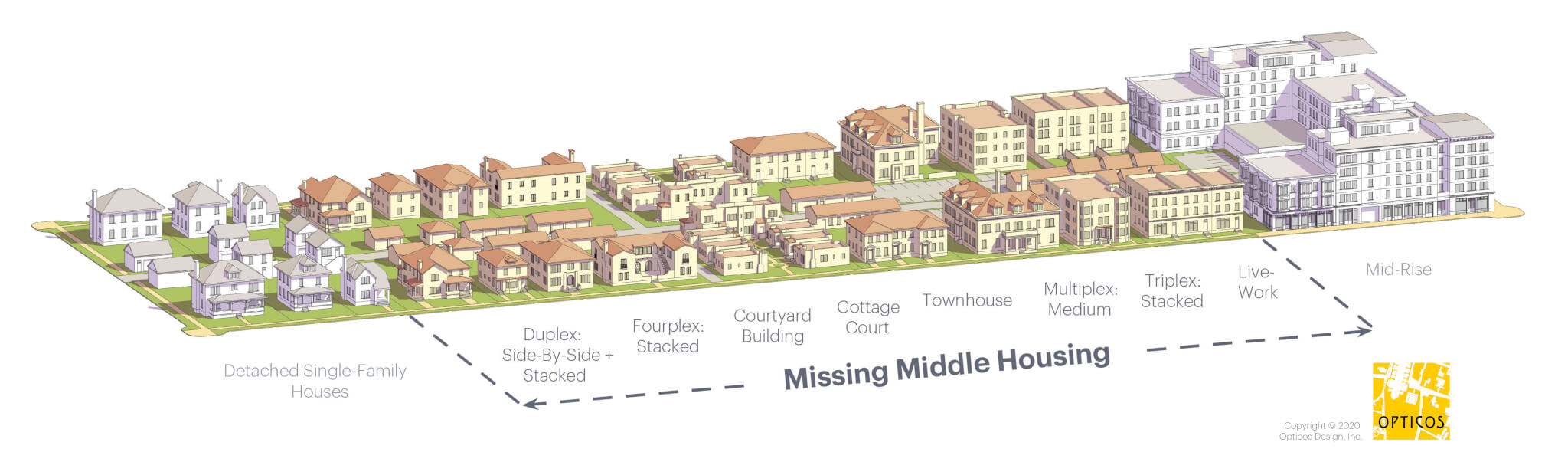
Missing Middle Housing responds to several key housing needs outlined in the toolkit:
- First-time homebuyers: In all seven counties that make up the Chicago metropolitan region, prices for single-family homes have risen twice as fast as incomes over the past decade, putting homeownership out of reach for more middle-income households. Missing Middle Housing types such as duplexes and fourplexes offer more attainable price points than single-family homes.
- Seniors downsizing: The region’s senior population continues to grow and now accounts for one in four households. Missing Middle Housing types offer smaller homes with less maintenance responsibilities and more shared open spaces that promote interaction and a sense of community.
- Cost-burdened households: Nearly half of renters and a quarter of homeowners are ‘housing cost-burdened,’ spending more than 30% of their income on housing costs. Missing Middle Housing development increases the supply and variety of housing price points in a community.
- Walkable living: According to the National Association of Realtors, 60 percent of people favor walkable neighborhoods environments with a mix of houses and stores rather than neighborhoods that require more driving between home, work, and play. Missing Middle Housing creates more homes in walkable neighborhoods and helps support nearby retail, amenities, and transit service.
- Small developer opportunities: Because of their simple forms, smaller size, and simple wood-frame construction, Missing Middle Housing types provide a low-cost to entry option for local builders.
Opticos Design is well known as the architects of the Missing Middle Housing movement. In 2010, Opticos Principal Dan Parolek coined the term, in 2014 they created the Missing Middle Housing diagram, in 2015 the company launched a free online resource for all: missingmiddlehousing.com and in 2020, Dan Parolek authored the book “Missing Middle Housing: Thinking Big and Building Small to Respond to Today’s Housing Crisis.” Opticos Design’s work in advocating for middle housing spans from designing middle housing types, master-planning walkable communities, analyzing barriers for communities across the Midwest and the country, and writing zoning that encourages middle housing types.