
Warrenville Horizon Senior Living
Warrenville
DuPage County
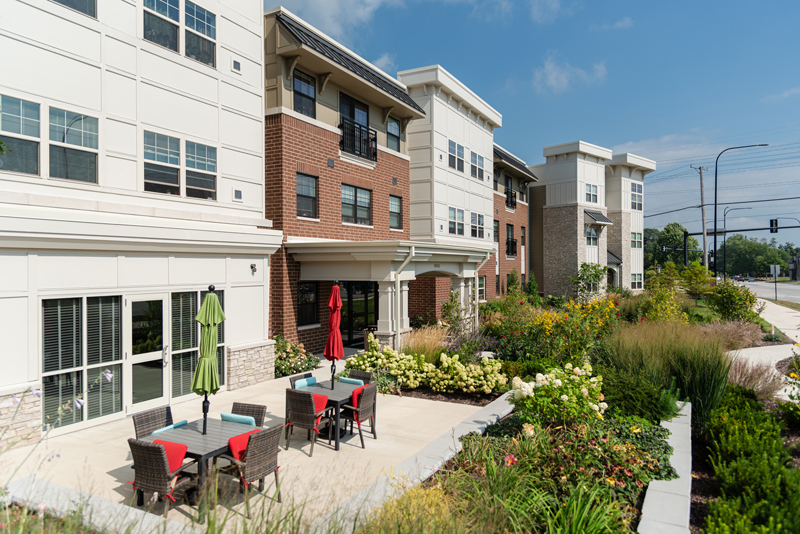
Photo courtesy of the Alden Foundation
The Development
The city of Warrenville’s first ever affordable senior housing development, Warrenville Horizon is a three-story, 71-unit building developed by the Alden Foundation– a Chicago-based nonprofit affordable senior housing developer with decades of experience in the field. While Warrenville leadership recognized its shortage of affordable housing, Alden recognized Warrenville’s high Quality of Life Index (QOLI) as providing a competitive edge for IHDA funding and approached Warrenville staff with the idea of developing an affordable independent senior apartment building in the community. After the relationship and mutual interests between Warrenville and Alden were solidified, Warrenville staff introduced Alden staff to four primely located underutilized lots at the corner of Butterfield and Batavia roads. These lots, located along the DuPage River, were earmarked by the city’s 2007 Old Town/Civic Center Subarea Master Plan as an important gateway site for a new downtown area. With Alden and Warrenville both in agreement on the site’s suitability for an affordable senior housing development, Alden began the acquisition process for the properties. All four lots were eventually acquired from four different owners and the proposal was able to move forward.
Alden worked with both city staff and community residents throughout the planning and construction process. Below are highlights of the collaborative planning process:
- Numerous revisions were made to original proposals to achieve a more modern and urban design, consistent with the most modern and sustainable energy practices. Though solar panels couldn’t fit into the initial budget, Alden assured city staff that solar panels would be installed should funding become available. This promise was met, as the development came in under budget and surplus funds were used to install the solar panels.
- The development site held a magnolia tree that would have to be torn down for any development of the site; and the community expressed a strong desire for its preservation. The solution, embraced by all parties, was to work with a local arborist to replant cuttings from the tree around the community, giving the tree another life.
- One final issue was the fact that the property contained a 100-year floodplain along the banks of the DuPage River, which Alden could not take possession of per HUD’s Floodplain Management and Federal Flood Risk Management Standard (FFRMS). The creative solution to the floodplain issue was to deed the floodplain to the Forest Preserve of DuPage County, which in turn preserved the natural riverbank and cleared the way for development.
After the roughly year-long collaborative planning process concluded (described by Alden staff as a “joy”), ground was officially broken in Spring 2020 and doors opened in October 2021. Even before construction was complete, the entire building was leased and a waiting list formed, evidence of the extremely high demand for affordable senior living options in the area.
The final product is a three-story, 71-unit building with a mix of 56 one-bedroom apartments and 15 two-bedroom apartments, 15 of which are reserved for senior households with incomes up to 30% AMI and 56 of which are reserved for senior households earning up to 60% AMI. All apartments feature spacious living areas with fully equipped kitchens, individually controlled heating and air conditioning, and a 24-hour monitored emergency pull cord. Additionally, building amenities include laundry facilities on every floor, storage units, a theatre room, fitness room, community room, arts and crafts room, community lobby, game room with a pool table and TV, a library with a fireplace, a calendar of events for residents, an outdoor patio with a grill, an on-site property manager, and a live-in maintenance manager.
Residents are also afforded a walkable lifestyle, located within a short walk to Warrenville Public Library, Warrenville Park District, city hall, the post office, a shopping center, and the Illinois Prairie Path. As hoped by the community, Warrenville Horizon’s opening almost immediately catalyzed private investment in the surrounding area, with several neighboring properties investing in exterior improvements and several stores opening nearby.
Goal
To provide quality affordable housing for senior households (62+) on four underutilized parcels of land in an envisioned new downtown Warrenville.
Target
Senior households (62+) earning between 30% and 60% of the Area Median Income (AMI).
Financing
With a total budget of approximately $21 million, financing included $16 million in federal Low-Income Housing Tax Credits (LIHTC), a $2 million permanent loan from IHDA’s Credit-Advantage first mortgage program, $2 million from DuPage County’s HOME funds, a ComEd energy efficiency grant, and construction financing from Bank of America and Enterprise Housing Credit Investments.
Success
The collaboration between Alden, the City of Warrenville staff, and Warrenville residents is a model example of public-private partnerships; highlighting the innovation possible in producing affordable housing when municipal leadership engages with expert affordable housing developers.
Lessons Learned
In municipalities where there is support from both city leadership and the wider community, there are high-capacity non-profit affordable housing developers who are able to not only develop the housing but also do so in a way that advances economic development, environmental, and other community goals. Further, these developers can support the community outreach, education, and response needed in respect of initial community concerns.
Contact Information
City of Warrenville Community Development Department, www.warrenville.il.us
This case study was last updated in February 2026.
See More Case Studies
Home Grown is a collection of housing best practices implemented by local governments across the seven-county Chicago region. Each case study covers a housing policy, development, or program; how it works; why it was successful; and how it was funded. To see the full collection of case studies, click on the Home Grown logo.