Chicagoland’s New ‘Feed the Cart’ Recycling Campaign Experts Offer Advice
Free events are on tap this weekend in the Windy City and beyond for volunteers seeking to promote cleaner and greener communities
CHICAGO (Nov. 13, 2025) – Several recycling-related events are scheduled in the Metro Chicago area around America Recycles Day, on Saturday, Nov.15, 2025. Events include hands-on workshops, community swaps, and educational sessions in Chicago and nearby suburbs. See the list of Chicagoland events below. Please feel free to share this article with your residents or use our Municipal Resources (bottom of webpage) to promote recycling in general.
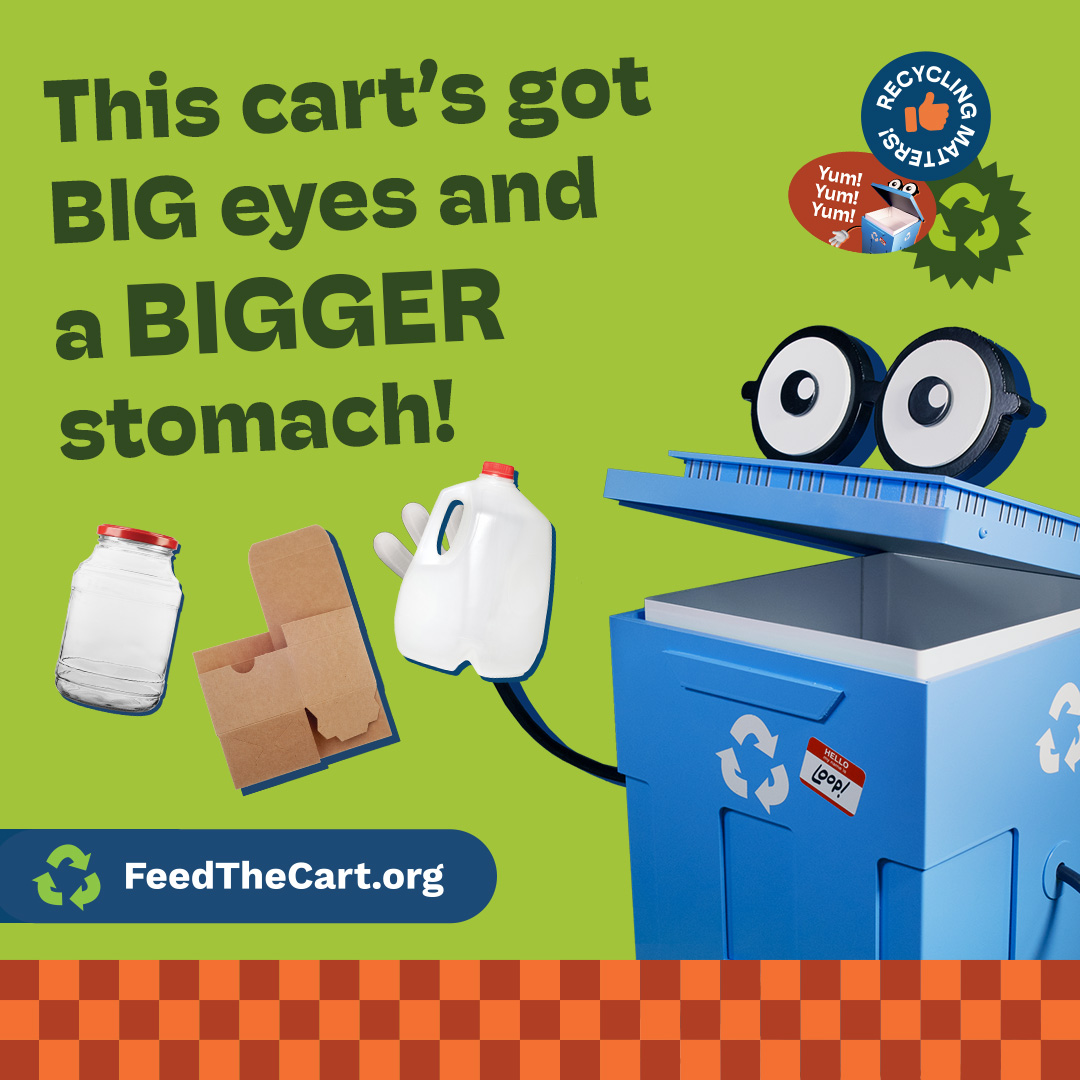 The America Recycles Day celebration aligns with the goals of leaders with the Metropolitan Mayors Caucus (MMC), a partnership of 275 local governments in Metro Chicago, which recently launched “Feed the Cart” — the largest recycling education and improvement campaign in Illinois’ history.
The ‘Feed the Cart’ recycling campaign covers six of the state’s most populous counties: Cook (including Chicago) (5 million people), DuPage (900,000), Kane (500,000), Lake (700,000), McHenry (300,000) and Will counties (700,000).
The campaign’s aim is to increase recycling tonnage across the Chicago metro region by 15% before 2030.
Here are the Top 5 recommendations from Chicagoland’s “Feed the Cart” campaign experts on how to support America Recycles Day on Saturday, Nov. 15.
- Get Involved in a Community Clean-Up: One of the best ways to celebrate America Recycles Day 2025 is to join in local efforts to clean up the community, said MMC Director of Environmental Initiatives Edith Makra. Clearing away litter keeps harmful waste out of ecosystems and makes public spaces more inviting. “Donating three or four hours of your time to pick up trash with like-minded people is a great way to connect with others who care about the planet and build lasting bonds as you work toward a common goal,” said Makra. Keep America Beautiful and https://feedthecart.org/ are great resources to find local community projects to help you on your way.
- Take the Plastic-Free Challenge: Go plastic-free for a day, a weekend, or even a week. Bring along reusable bags, bottles and containers, and experiment with sustainable swaps for everyday items. “You might find it surprisingly easy to make small, sustainable changes and even more eye-opening to see how reliant we’ve become on plastics,” said Solid Waste Agency of Northern Cook County Executive Director Christina Seibert. “The more people participate, the closer we get to a world less burdened by plastic pollution.”
- Buy Recycled – A lot of people complain that they can’t recycle all the things they want to recycle. But just like with anything else, recycling is, to a certain extent, driven by demand. “That means when you buy products made from recycled material, you’re helping support the whole process by contributing to the market for recycled goods,” said Marta Keane, Will County Certified Sustainable Resource Management Professional Recycling Specialist in Joliet. She notes that all aluminum cans have recycled content, as do all newspapers, cereal boxes, glass bottles, jars, and all steel items.
- Educate Yourself and Others: To truly make a positive impact, start by learning the importance of recycling and why sustainable living is so important, suggests Walter Willis, Executive Director of the Solid Waste Agency of Lake County (SWALCO), a regional body that promotes recycling and waste management. “The old saying is true: Knowledge is power, and every conversation you start can inspire others to recycle more and participate in local recycling efforts,” said Willis.
- One last thing: don’t be shy! Visit https://feedthecart.org/ and contact local recycling centers to ask how you can get involved, or connect with Keep America Beautiful chapters that may need volunteers for cleanup drives or other events. “Getting to know the people who commit daily to uplifting the planet and cleaning up the environment will be a great source of inspiration as well as education, and America Recycles Day 2025 is the perfect time to do it,” said Kane County Recycling Coordinator Clair Ryan.
Here is a summary of Chicagoland activities relevant to “America Recycles Day 2025”:
Chicagoland Community Cleanups, Reuse & Upcycling Events: Extend the life of your items and participate in community sharing, including:
- Craft Swap: A chance to pick up free craft supplies from the community.
- Venue: Niles-Maine District Library (Niles)
- Date: Saturday, November 15, 2025
- Time: 10:00 a.m.
- Rethread at the Shed: Quilting Bee: Use 100% reclaimed textiles to create a scrappy quilt in this community sewing fundraiser.
- Venue: The WasteShed (Chicago)
- Date: Sunday, November 16, 2025
- Time: 1:00 p.m.
- Mend with Friends: A Community Repair Workshop: Learn how to mend your clothes to reduce textile waste.
- Venue: Chicago Fair Trade Museum (Chicago)
- Date: Thursday, November 20, 2025
- Time: 5:30 p.m.
- Puzzle and Gift Wrap Swap: Exchange puzzles and unused wrapping supplies.
- Venue: Evanston Public Library (Evanston)
- Date: Saturday, November 15, 2025
- Time: 3:00 p.m.
- Community cleanups: Help reduce waste and litter in local areas.
- Trash People of West Town – Sunday Morning Community Clean Up: The final cleanup of the year for this community group.
- Venue: Midwest Coast Brewing Company (Chicago)
- Date: Sunday, November 16, 2025
- Time: 10:45 a.m.
- Vedgewater Community Garden Work Day: A volunteer day focused on promoting ecological resilience in the garden.
- Venue: Vedgewater Community Garden (Chicago)
- Date: Saturday, November 15, 2025
- Time: 10:30 a.m.
- Shoes, Shred, & Seeds Event in Wauconda
- SWALCO is partnering with the Village of Wauconda for a Shoes, Shred, and Seeds event!
- Date: Saturday, November 15, 2025
- Venue: Wauconda Public Works (302 Slocum Lake Road)
- Time: From 9:00 AM to 12:00 PM
- Donate your shoes through SWALCO and the Village of Wauconda’s Reuse-A-Shoe program, one of SWALCO’s largest Reuse-A-Shoe partners in Lake County.
- You will also have the opportunity to shred your confidential documents (limit of 6 boxes per vehicle) and get a packet of seeds for plants that will benefit pollinators (limit one per vehicle while supplies last).
- This event is for households/residents only—no businesses.
- Collected items will be reused and recycled.
- Ongoing recycling opportunities: Household Chemicals & Computer Recycling Facility
- A year-round facility for dropping off chemicals and electronics.
- Location: 1150 N. North Branch Street (Chicago)
- Hours: Tuesday (7 a.m.–12 p.m.), Thursday (2–7 p.m.), First Saturday of the month (8 a.m.–3 p.m.)
- Ongoing recycling opportunities: Household Chemical Waste recycling service is available in Gurnee (visit http://www.swalco.org/165/Residential-HCW-Collection-Options)
- Ongoing recycling opportunities: Household Chemicals & Computer Recycling services are also available in Naperville (visit
https://www.naperville.il.us/services/garbage-and-recycling/household-hazardous-waste-facility/), and Rockford (visit https://www.rockfordil.gov/492/Household-Hazardous-Waste-Disposal. - Ongoing recycling opportunities: SWALCO’s year-round electronic drop-off sites are available at: http://www.swalco.org/163/Electronics-Year-Round-Drop-Off-Location
- Ongoing recycling opportunities: SWALCO also offers a year-round Clothing and Textile Collection program. New and gently used donations are tax-deductible and get reused. Worn, torn, and stained items get recycled/upcycled. View the list of drop-off locations across Lake County: https://www.swalco.org/188/Clothing-Textiles-Drop-Off-Locations
- Chicago Residential Recycling Drop-Offs: The City of Chicago offers drop-off sites with blue recycling dumpsters, available during daylight hours; site locations and acceptable materials are available at https://www.chicago.gov/city/en/depts/streets/supp_info/recycling1/find_a_residentialrecyclingdropoffcenter.html.
- Recycle Coach: Residents of any Chicagoland community can visit feedthecart.org and search Recycle Coach for information on managing all your discards, including drop-off options for reuse and recycling, and which cart to put them into at home.
BACKGROUND:
What is ‘America Recycles Day”?
Created in 1997, America Recycles Day takes place each year on November 15 and is the only nationally recognized day dedicated to promoting recycling and educating the public about its benefits. Keep America Beautiful invites the public to test their recycling knowledge with its online quiz at kab.org and to review local recycling guidelines before tossing items into the bin.
What is the new Chicagoland “Feed the Cart” campaign?
The Caucus and its Chicago Metro Recycling Education and Outreach (REO) campaign partners, including the Solid Waste Agency of Northern Cook County (SWANCC) and the Solid Waste Agency of Lake County (SWALCO) as well as DuPage, Kane, McHenry, and Will counties, were awarded a $2 million grant in 2024 from the U.S. Environmental Protection Agency (EPA) to promote recycling education and outreach — the largest allocation of its kind to Illinois in more than three decades.
Recycling programs in the Chicago area are well-established, as surveys show a majority of residents embrace recycling as a daily sustainability action they can take.
The total amount of regional recyclable materials collected in 2024 was nearly 573,000 tons — which is the equivalent of filling Soldier Field with recyclables an estimated 6 times, or the Chicagoland Speedway in Joliet full of recyclables to a height of about 57 feet high, and would weigh the equivalent of nearly three Willis Towers.
At the same time, the diversion rates in the Chicagoland region are stalled at 30-35%.
While this is on par with the national average of 32%, it is not sufficient to meet either the EPA’s National Recycling Goal of 50% by 2030 or the Metro counties’ individual diversion goals. In addition, data show that contamination in Chicagoland’s recycling stream is a significant problem, which increases the cost of recycling that is borne by municipalities and residents.
While 87% of Americans say recycling is important, confusion, inconsistent rules, and lack of access are keeping recycling rates low. According to the U.S. Environmental Protection Agency, only about 32% of household waste is recycled or composted, a figure that has remained steady for nearly a decade. According to the survey, nearly two-thirds (62%) of Americans give themselves an “A” or “B” grade for their recycling habits, but most failed basic questions about what can be recycled.
Despite these gaps, there are encouraging signs about Americans’ recycling beliefs:
- Nearly 9 in 10 Americans agree that recycling helps the economy.
- Three out of four (75%) correctly recognize that recycling saves more energy than it uses.
- 78% say they don’t believe recycling is a waste of time — they know it makes a difference.
The Chicagoland “Feed the Cart” awareness push is highlighted by the introduction of “Loop,” a cartoon-like mascot that will serve as the recycling campaign’s education champion. The goals of the campaign are to:
- Engage Chicagoland residents by promoting the environmental and economic benefits of recycling.
- Educate residents to increase recycling and reduce contamination at the community level.
- Improve the quality of materials placed into the recycling stream throughout the region, resulting in a less contaminated, more marketable stream of recyclables.
- Encourage residents and businesses to “buy recycled,” to seek out products made from recycled material or packaged in post-consumer recycled content.
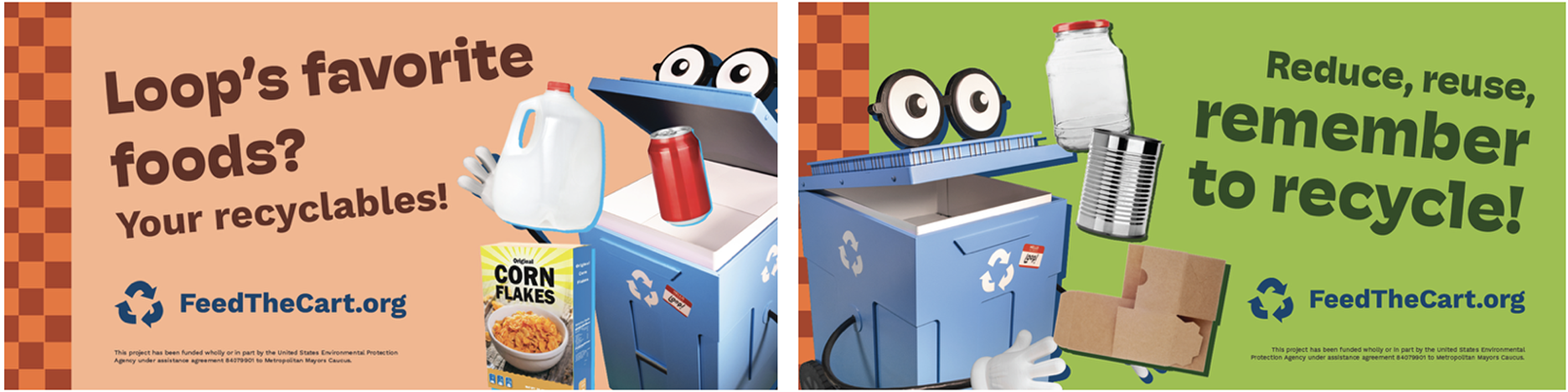
Education tactics for the “Feed the Cart” campaign will include marketing, a new website — FeedTheCart.org — and social media presence, advertising, public relations, and grassroots, community-level outreach.
The Caucus will measure the impact of the three-year campaign and issue a report with its results upon completion in 2027.