
School House Apartments
Cary
McHenry County
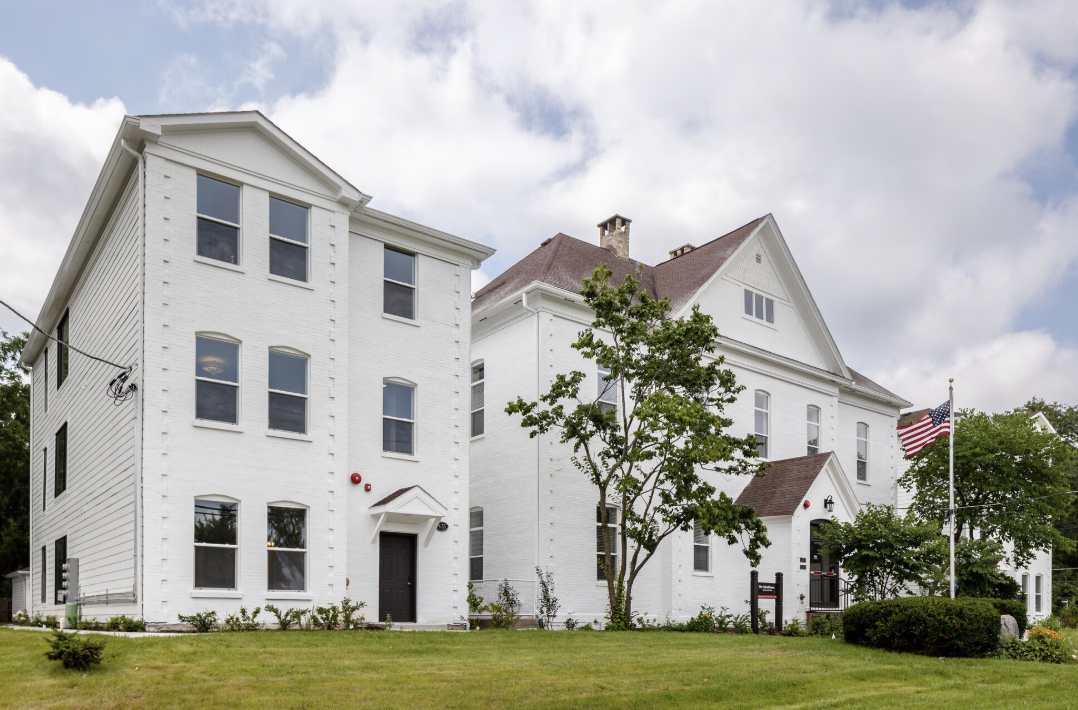
Photo courtesy of True North Properties
The Development
The Kraus Senior Center at 441 S. Main Street, located in the historic Cary Public School Building just a half mile from downtown Cary, stood vacant for roughly a year after senior center activities (which had operated out of the building since 2003) were relocated to a newer, more accommodating community center. Just a year prior to the relocation of the senior center, the village of Cary and the Regional Transportation Authority began the process of creating a new downtown strategic plan aimed at guiding future investment and development. Important to the adopted plan were the goals of increasing density and maximizing land-use efficiency near the downtown core, which would likely necessitate rezoning. Also considered in the plan was the redevelopment of vacant and underutilized buildings or sites near downtown, one of which being the site of the old Cary Public school. Thus, when senior center activities were relocated out of the 441 S. Main Street building, the village quickly identified the site’s redevelopment as aligning with its new downtown strategic plan and put out an RFP for the site’s adaptive re-use.
True North’s initial proposal was warmly received by the village board and was only slightly adjusted after input from board members and residents. The original plan proposed the construction of three new three-story buildings but was scaled back to the construction of two new three-story buildings. The main concerns were the development’s size and landscape buffering, but this didn’t lead to broader opposition. After an impressively quick turnaround, the village approved both the $100,000 sale of the old schoolhouse and the rezoning of its lot. Just three years after the senior center’s relocation, Cary Schoolhouse Apartments opened its doors in 2024 and is now fully leased.
The old schoolhouse building was remodeled into four luxury apartments with special attention paid to its historical character; and two additional three-unit luxury apartment buildings were also constructed on the site (for a total of ten rental units). There are 2-bed/1-bath and 3-bed/2-bath options, ranging in size from 900 to 1,300 square feet that rent at market-rate. Each apartment comes with its own garage space but is also in a prime location, within a short walk from downtown Cary, the Cary Metra station, and several parks, schools, and churches. Since its completion, it’s been touted by neighbors and village leaders alike for its creative re-use and appealing design.
Goal
To repurpose a vacant and historically/architecturally significant building, keeping it in use and returning it to the tax rolls, while also increasing Cary’s housing supply, diversifying its housing type, and increasing density around downtown Cary and its Metra station.
Target
Renters in Cary
Financing
The village of Cary sold the site to True North Properties, Inc. for $100,000, who developed the School House Apartments entirely with private funding.
Success
The redevelopment of the historically and architecturally significant Cary Public School building into a 4-unit luxury apartment building allowed the Village to preserve its beauty and value. Further, the additional construction of two new 3-unit apartment buildings on the school grounds (bringing the total apartments created to 10) helped advance the Village’s goals of increasing its housing supply and diversifying its housing type. The process was both public-engaging and efficient, experiencing little-to-no pushback from community members, neighbors, or village board members.
Lessons Learned
Repurposing a vacant, city-owned building for multifamily housing, through a Request for Proposals (RFP), can be a quick process when there is consensus among stakeholders on the development’s value. Additionally, the adaptive reuse of historic and architecturally significant buildings into multi-family housing can create a unique housing opportunity which is supported by a wide range of stakeholders.
Contact Information
Village of Cary Community Development Department: www.caryillinois.com
This case study was last updated in February 2026.
See More Case Studies
Home Grown is a collection of housing best practices implemented by local governments across the seven-county Chicago region. Each case study covers a housing policy, development, or program; how it works; why it was successful; and how it was funded. To see the full collection of case studies, click on the Home Grown logo.