
Mallinckrodt in the Park
Wilmette
Cook County
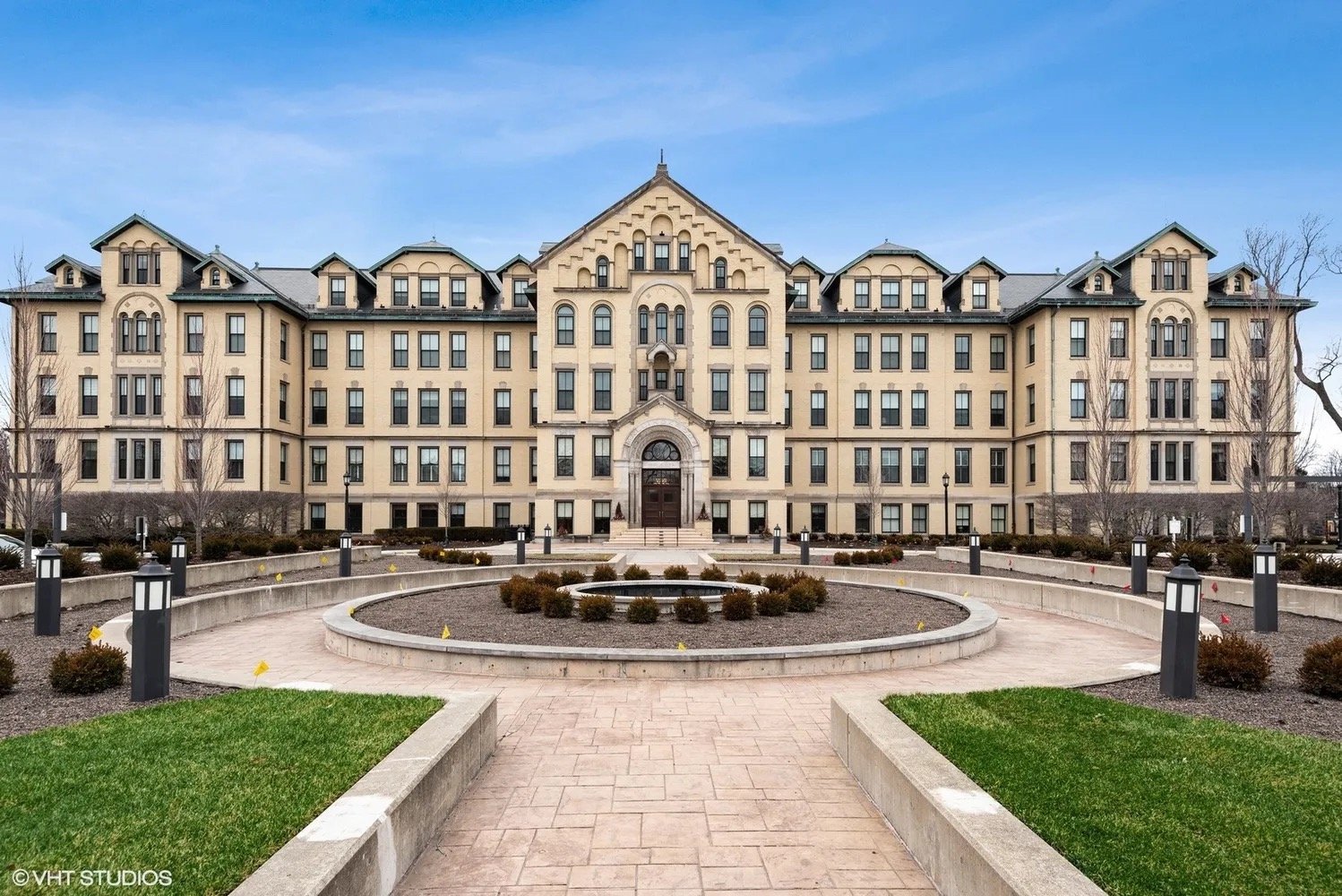
Photo courtesy of Mallinckrodt in the Park
The Development
Mallinckrodt’s five-story, 180,000 square foot Italian Renaissance structure has been a celebrated fixture of the Wilmette landscape since 1918. Originally a convent, Mallinckrodt College was later part of Loyola University. In 2001, after Loyola University’s Board of Trustees decided to relocate its operations, residents presented a petition with nearly 5,400 signatures—representing nearly one-third of the community’s 18,000 registered voters—to the Board of Park Commissioners requesting that the community be given the right to vote on whether the Park District should purchase the historic building and its land. In spring 2002, residents approved a referendum authorizing the Park District to acquire the land at a cost of $1 million per acre. The Park District was initially focused on the property’s green space and did not have a plan for the building itself. Residents campaigned for senior housing and initially opposed the developers’ plans to clear the front of the property for an underground parking garage, but once the public understood the developers’ intentions to replant the area once the garage was in place, they dropped their opposition. The developers purchased the building and a total of 3.5 acres from the Park District for $3.5 million.
The Village retained Hasbrouck Peterson Zimoch Sirirattumrong of Chicago, an architectural and planning firm, to conduct a feasibility study to determine the Mallinckrodt building’s potential for adaptive reuse. The Village changed its zoning code to include “adaptive reuse senior housing” as a special use and received approval from the Zoning Board of Appeals to allow the development to move forward. After issuing a request for proposals for the building’s redevelopment, The Pickus Companies won the bid and the development was realized.
The final product converted the old college building into 81 senior condominiums, 12 of which were negotiated by the village to be affordable. To qualify for an affordable condominium in Mallinckrodt in the Park, households must earn at or below 100% of the area median income (AMI), which is $96,000 for a two-person household in 2026. The annual rate of increase in value of the affordable homes are capped at three percent as a requirement of a deed restriction attached to the property, and the affordable units are resold to applicants on a waiting list. During the initial sales period, the community was surprised to learn that there was a strong market for affordability in the village. Out of 91 applications for 12 affordable condominiums, half came from Wilmette residents.
Goal
To preserve an architecturally significant building beloved by the community while increasing the village’s stock of senior housing options.
Target
Wilmette’s senior population (55+).
Financing
The village purchased the property for $20 million and re-sold it to the Park District for $1, who then sold 3.5 of 17 acres- which included the building- for $3.5 million.
Success
Preserving the Mallinckrodt College building saved the Park District $5 million in demolition costs. In addition, this adaptive reuse created a new source of tax revenue for the community with no additional demand on schools. It was a clear example of preservation, open space and housing all working together to maintain the historic character of the building and neighborhood.
Lessons Learned
Preserving historic and/or architecturally significant buildings rather than demolishing them can maintain valuable community assets and save money. Additionally, community groups working together for affordable housing can succeed even if it does not seem to be a popular cause.
Contact Information
Village of Wilmette Community Development Department: https://www.wilmette.gov/164/Community-Development.
This case study was last updated in February 2026.
See More Case Studies
Home Grown is a collection of housing best practices implemented by local governments across the seven-county Chicago region. Each case study covers a housing policy, development, or program; how it works; why it was successful; and how it was funded. To see the full collection of case studies, click on the Home Grown logo.