
Inclusionary Housing Ordinance
Evanston
Cook County
Evanston’s Inclusionary Housing Ordinance requires new and redeveloped residential projects of seven or more units to provide a share of affordable housing using flexible compliance options, incentives, and a tiered fee structure to maximize affordable unit production while accommodating local market conditions.
Background
Evanston adopted its original Inclusionary Housing Ordinance (IHO) in 2007 to increase the supply of affordable housing in new developments. Under the original version of the ordinance, projects had to be for-sale, planned developments with 25 units or more for the IHO to apply. In 2016, Evanston amended the IHO to apply to rental developments and tailored affordability requirements depending on whether a development was located in a transit-oriented development (TOD) area or not.
In December 2023, Evanston’s City Council approved a goal to amend the IHO in 2024. The update was designed to strike a balance of maximizing affordable housing production without discouraging overall housing production. Staff began by identifying technical gaps and administrative hurdles, then completed a thorough analysis of previous outcomes in light of the Council’s goal of creating on-site affordable units rather than generating in-lieu fees.
How It Works
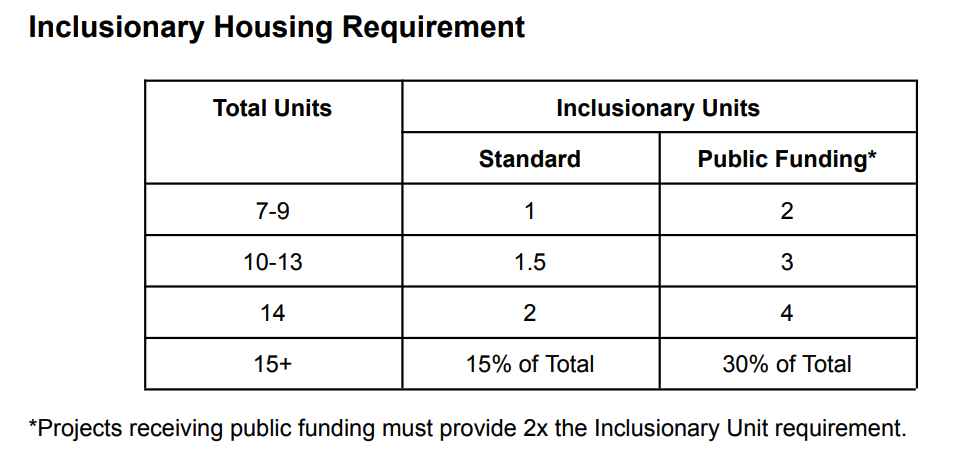
The revised ordinance, adopted in February 2025 and effective April 1, 2025, establishes a 15% affordable housing requirement for developments with seven or more units. This marks an increase from the previous 10% requirement, which in practice often resulted in only 7–10% of units being affordable due to technical language. The new 15% threshold aligns with the county’s affordable housing special assessment program, which offers property tax relief to developments that meet or exceed this level. As in previous versions of Evanston’s IHO, developments receiving public funding—such as tax credits or TIF support—must provide double the standard inclusionary housing requirement (i.e., 30% rather than 15%).
The ordinance applies to developments of seven or more units of various types, including:
- New residential or mixed-use development.
- Redevelopment that changes the tenure from rental to for-sale or for-sale to rental.
- Redevelopment that changes the number of bedrooms or size of dwelling units.
- Redevelopment that changes the use to residential.
- New residential component to existing development.
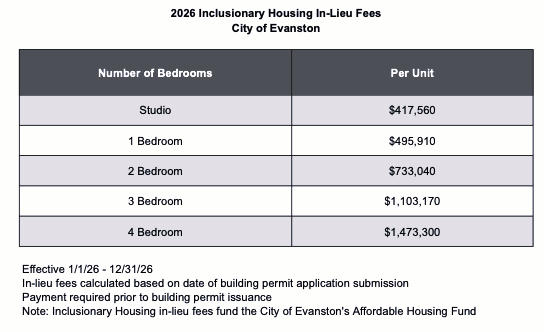
To comply, developers may build affordable units on-site, pay an in-lieu fee to the City’s affordable housing fund, or submit an alternative compliance proposal for City Council approval, showing affordability goals are met to an equal or greater extent. The ordinance strongly encourages on-site production – reflecting the City Council’s goal for the ordinance – through a revised fee in lieu amount and continued use of incentives:
- Waived and deferred building permit fees.
- Zoning bonuses and reduced parking requirements.
- A managed, centralized waitlist of potential tenants.
During the update process, some developers noted that the prior in-lieu fee amount was too low if the City’s goal was to encourage affordable unit production rather than fee collection. To recalibrate the fee amount, staff analyzed 20 residential developments in Evanston constructed from 1995-2024, calculated the 30-year difference in rental income between affordable and market-rate units, and set new fees to reflect these long-term trade-offs. The revised fee structure is tiered by unit size, with lower fees for studios and higher fees for larger units. This methodology ensured fees reflected the actual financial difference between including an affordable unit and not.
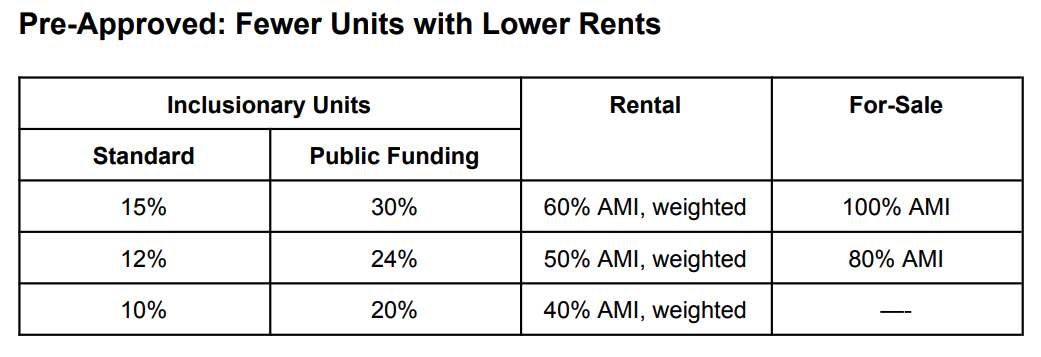
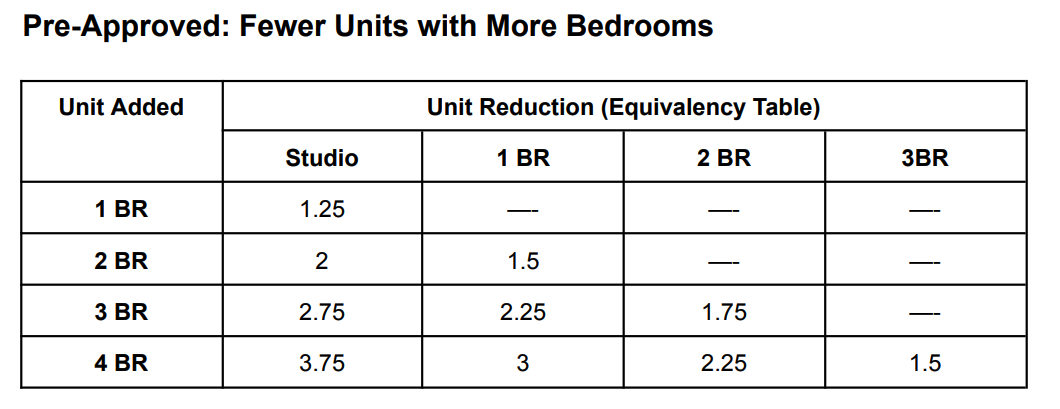
The policy evaluation process revealed that the previous IHO was most successful at producing smaller apartments within high-rise buildings affordable to smaller households earning 50-60% of the area median income (AMI). To encourage production of housing that meets the needs of other households, the updated ordinance includes pre-approved compliance options allowing slightly lower affordable unit percentages if developers provide deeper affordability or larger family-sized units. Previously, developers had to request special approval from the City Council to propose these alternatives, adding complexity and delays to the process. The update also introduced a stepped approach for smaller multifamily buildings with 7–14 units, requiring a slightly lower share of affordable housing, recognizing that these projects are more likely to be developed by smaller-scale builders operating with tighter margins.
Evanston’s process and updated ordinance were based on the belief that every housing market is different, and every municipality needs a tailored ordinance. While reviewing other cities’ approaches is useful, tailoring the ordinance—its thresholds, incentives, and fee structures—to Evanston’s specific housing market and goals was essential. Recognizing that markets evolve, the new ordinance includes an annual reporting requirement to promote transparency, accountability, and continuous refinement.
Goal
Increase on-site affordable housing production in new developments without stifling overall housing growth.
Target
Households earning up to 60% of the area median income (AMI) for rental units and up to 100% AMI for owner-occupied units.
Success
12 inclusionary units built under 2007 IHO (2007 to 2015).
43 inclusionary units built under 2016 IHO (2016 to 2018).
67 inclusionary units built or under construction from 2019-March 2025 (2019 IHO).
92 additional inclusionary units approved and applying for permits from 2019-March 2025 (2019 IHO).
Lessons Learned
A data-driven approach tailored to local market conditions is essential for effective policy design. Communities must clearly define their ordinance goals in terms of prioritizing on-site unit production versus fee generation, specific unit types, or target income levels. While inclusionary housing ordinances are valuable tools, they are not comprehensive solutions and must be complemented by additional strategies to address the full spectrum of housing needs.
Public Involvement
Staff conducted over 20 interviews, engaging developers who had previously participated in the IHO process, along with land use and real estate attorneys, realtors, property managers, community organizations, the Community Investment Corporation, DePaul Institute for Housing Studies, and national experts such as Grounded Solutions and the Housing Solutions Lab at NYU. Key takeaways from developers included a desire for greater predictability and increased flexibility within pre-determined outcomes the City wanted, such as larger units or deeper affordability.
Public meetings featured focused outreach to community organizations and residents most affected by the policy, as well as developers who were active in Evanston and had provided early input through interviews. Several developers expressed support for the ordinance, and the City encountered general consensus with minimal conflict during this stage. Throughout, the process was overseen by the City’s Housing and Community Development Committee.
Key Updates to Evanston’s Inclusionary Housing Ordinance
Contact Information
City of Evanston Community Development Department, www.cityofevanston.org
This case study was last updated in February 2026.
See More Case Studies
Homegrown is a collection of housing best practices implemented by local governments across the seven-county Chicago region. Each case study covers a housing policy, development, or program; how it works; why it was successful; and how it was funded. To see the full collection of case studies, click on the Homegrown logo.