
Hope Manor
Joliet
Will County
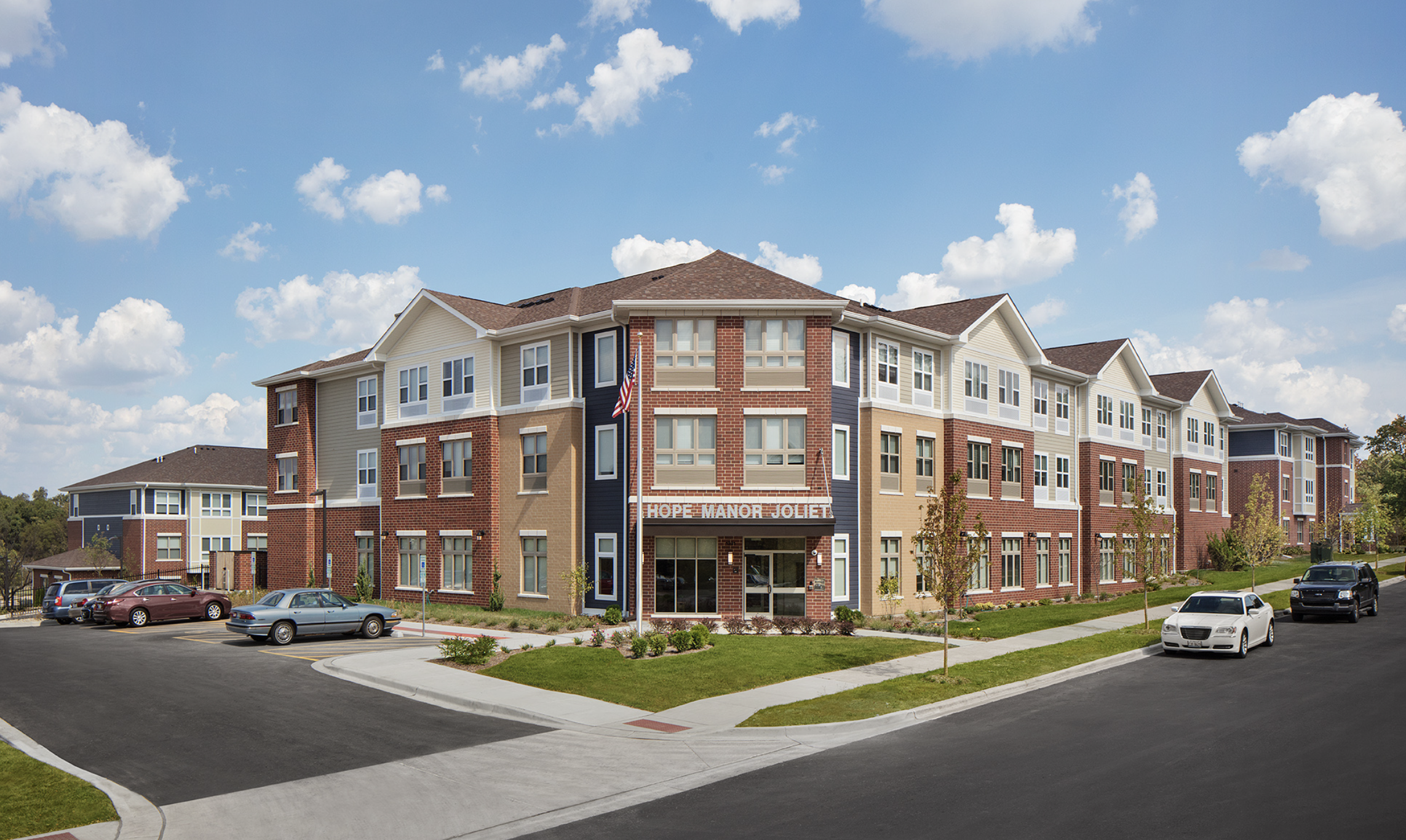
Photo courtesy of WJW Architects
The Development
Hope Manor Joliet was one of several outcomes of Silver Cross Hospital’s 2008 announced plans to build a new 77-acre facility in nearby New Lenox. A fixture of the city of Joliet’s east side since 1895, the hospital’s leaders promised the city and community that the site’s redevelopment would benefit Joliet residents’ quality of life. This promise led to the creation of the Silver Cross Healthy Community Commission, a group comprised of 17 eastside Joliet community leaders and hospital administrators tasked with redeveloping the 35-acre campus.
The first major improvement initiated by the Healthy Community Commission was the 2013 opening of a Veterans Administration (VA) mega-outpatient clinic in the former Silver Cross Emergency Department; which required the petitioning of VA secretary Eric K. Shinseki by local veterans’ groups and lawmakers to open negotiations with Silver Cross, where he eventually agreed to purchase the 4.4-acre property. Shortly thereafter, Silver Cross donated 2.2-acres of the campus and provided $550,000 in operational support to non-profit healthcare provider Aunt Martha’s for the opening of a federally qualified healthcare center (FQHC). Then, in 2014, recognizing the critical demand for affordable supportive housing for veterans in Joliet, the Healthy Community Commissions approached non-profit affordable housing developer Volunteers of America Illinois (VOAIL), one of the largest owner/operators of affordable housing in the country with two supportive veteran housing developments in Chicago, with interest in transforming 8.8-acres of the campus’ surface parking lots into supportive veteran housing.
With widespread support for the development from both the community and city leadership, VOAIL readily accepted the proposal to build its fourth supportive veterans’ housing development on the campus and purchased the 8.8-acres from Silver Cross for $25,000- just enough to cover the property transfer costs. Additionally, the city obtained and donated to VOAIL a piece of wooded land immediately adjacent to the site so that the proposed building density would comply with the area’s existing zoning regulations.
Designed by WJW Architects and constructed by JJ Duffy Co., Hope Manor Joliet is a complex of four 3-story apartment buildings surrounding a community park space with walking paths, a picnic area, and a playground. Prioritized for veterans and veteran-headed families, of the 67 total apartments, 32 are one-bedroom apartments, 18 are two-bedrooms, and 17 are three-bedrooms. In addition to being a veteran-headed household, all apartments are reserved for households earning up to 60% AMI. More specifically, 14 apartments are reserved for those earning up to 30% AMI; 24 are reserved for those earning between 30% and 50% AMI, and the remaining 29 are reserved for those earning between 50% and 60% AMI.
The “main” building’s ground floor provides ample space for various support services including a community room, classrooms, a business center and library, a training room, and a children’s resource room complete with computers, a play area, reading nook, and a homework area. These spaces are used by VOAIL and local community service providers to offer both residents and non-resident veterans services like mental health screenings, individual and family counseling, parenting classes, youth programs, peer support groups, access to recovery resources, job training, computer training, and food assistance, among others. On the top two floors of the main building are 32 one-bedroom apartments reserved for single veterans, and, because the main building is the sole structure among the four with an elevator, seven of the apartments are fully accessible. The remaining 35 apartments are all family-sized and reserved for veteran-headed families; with a mix of two- and three-bedroom apartments spread throughout the three other buildings. All apartments come fully furnished and feature fully equipped kitchens, forced heating and air conditioning, and high-speed internet access. In addition to being located directly adjacent to both the VA mega-clinic and Aunt Martha’s FQHC, Hope Manor residents are within walking distance of the elementary and middle schools, a PACE bus stop, two grocery stores, a public park, a restaurant, daycare, and church.
Goal
To provide affordable supportive housing to veterans and veteran-headed families who are homeless or at-risk of homelessness, helping them to improve their lives by providing stable housing, promoting self-sufficiency, building new skills, creating strong support networks, and being integrated into the community.
Target
Veterans and veteran-headed families with annual incomes up to 60% of the Area Median income (AMI), who may be homeless, at-risk of homelessness, or experiencing housing insecurity. Hope Manor Joliet is one of the few supportive housing communities serving veterans and their children.
Financing
With a total development cost of $19 million, financing included 9% LIHTC equity, a 30-year loan from the Federal Home Loan Bank of Chicago, deferred developer fees, a Home Depot Foundation grant, a donation from Niagara Bottling LLC, and a grant from the Capital Magnet Fund. All apartments in Hope Manor Joliet are subsidized so that residents only need to pay 30% of their income, 17 through the HUD-Veterans Affairs Supportive Housing program and the remaining 50 through Project-Based Vouchers (PBVs) issued by the Housing Authority of Joliet (HAJ). Originally, this development received these PBVs through the Regional Housing Initiative (RHI), and were always intended to be administered by HAJ, which itself would not have had enough to award were it not for RHI.
Success
Where roughly a decade prior, a vacant hospital campus loomed with uncertainty amidst an economic crisis, Hope Manor Joliet now provides 67 veteran-headed households with quality affordable housing and access to an array of support services, all while acting as an anchor to a vibrant new mixed-use development. Not only widely regarded as a success locally, Hope Major Joliet received national recognition in receiving the Charles L. Edison Tax Credit Excellence Award.
Lessons Learned
On large campuses which have either been vacated or are nearly vacated – as in the case of moved hospitals like Silver Cross or in similar cases like un-occupied corporate parks or abandoned malls – the development of affordable housing is a market-proven, effective strategy in the redevelopment of those campuses. Further, affordable family housing developments which also provide support services and are targeted towards specific groups- like veteran-headed families in the case of Hope Manor or single-mothers in similar developments – seem to garner more community support than less-targeted affordable developments.
Contact Information
City of Joliet Community Development Department, www.joliet.gov
This case study was last updated in February 2026.
See More Case Studies

Home Grown is a collection of housing best practices implemented by local governments across the seven-county Chicago region. Each case study covers a housing policy, development, or program; how it works; why it was successful; and how it was funded. To see the full collection of case studies, click on the Home Grown logo.