
Hometown
Aurora
Kane, DuPage, Kendall, and Will Counties
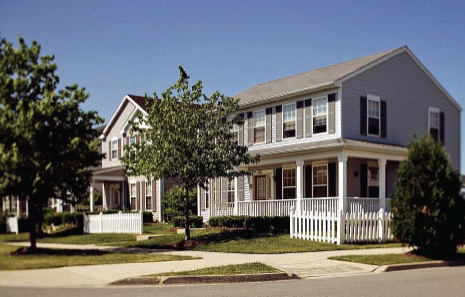
Photo courtesy of the Metropolitan Planning Council.
The Development
When Bigelow Homes designed Hometown Aurora, the idea was to re-create a small, pre-World War II, Midwestern town, with cultural and economic sustainability and diversity. Located on the east side of Aurora, an area that was a target of significant residential growth in the early 2000s, the neighborhood was designed to foster community, enhance the natural environment, provide diverse housing options for diverse household types, and build the local tax base.
With eight pedestrian-friendly, compact, traffic-calmed neighborhoods, and a commercially viable and socially appealing town center, Hometown includes 1,288 units, comprised of a mix of detached and attached single-family homes and loft-style homes. Half of the total homes are two-bedroom units, 40% are three-bedroom units, and the rest are four-bedroom units. Of the 1,288 total units, 600 were initially sold at prices affordable to households with incomes up to 80% of the area median income (AMI). Hometown’s affordability is strictly a result of the variety of housing products it offers and its compact design; there are no subsidies or long-term pricing restrictions associated with any of the units in Hometown.
Hometown balances common open space with small private lots, allowing for a range of housing types and price points. Because of the neighborhood’s compact design, assessed valuation is more than twice that of other new subdivisions in the area, and, due to narrower streets in its compact design, the development required far less public street development which allowed for the preservation of 273 acres of open space. The homes have appealed to a wide range of household types, from singles to empty-nesters, young couples without children, and families.
From a planning perspective, Hometown Aurora now stands out as a strong example of New Urbanist principles applied in practice. While some challenges can still be recognized, the overall planning framework has proved resilient and has met community needs. As hoped, Hometown has successfully provided varied housing options within a compact neighborhood design which has allowed for an economically diverse community and a strong tax base.
Goal
Hometown Aurora was designed to create a vibrant community that provides diverse housing options and builds the local tax base.
Target
Households with a range of sizes and incomes.
Financing
Hometown was funded privately with a standard Federal Housing Administration (FHA) Loan.
Success
Hometown has succeeded in developing a strong sense of community due to the neighborhood’s walkable layout, access to shared spaces, and proximity to amenities, which has helped foster social cohesion and neighborhood pride. Economically, Hometown Aurora has contributed positively to the local tax base and housing market by offering a mix of housing types that appeal to a range of households. Its traditional neighborhood design has maintained property values, and there continues to be strong demand to live in the neighborhood.
Lessons Learned
One of the challenges in building Hometown was that the model of development didn’t fit with traditional city codes and zoning practices. Many of the aspects that contributed to Hometown’s affordability and sustainability (i.e. narrow streets and smaller lot sizes) required extensive negotiations between Bigelow Homes and City representatives. This entitlement process took two years to complete.
Contact Information
City of Aurora Community Development Department, www.aurora.il.us
This case study was last updated in February 2026.
See More Case Studies
Home Grown is a collection of housing best practices implemented by local governments across the seven-county Chicago region. Each case study covers a housing policy, development, or program; how it works; why it was successful; and how it was funded. To see the full collection of case studies, click on the Home Grown logo.