
Harvey Lofts
Harvey
Cook County
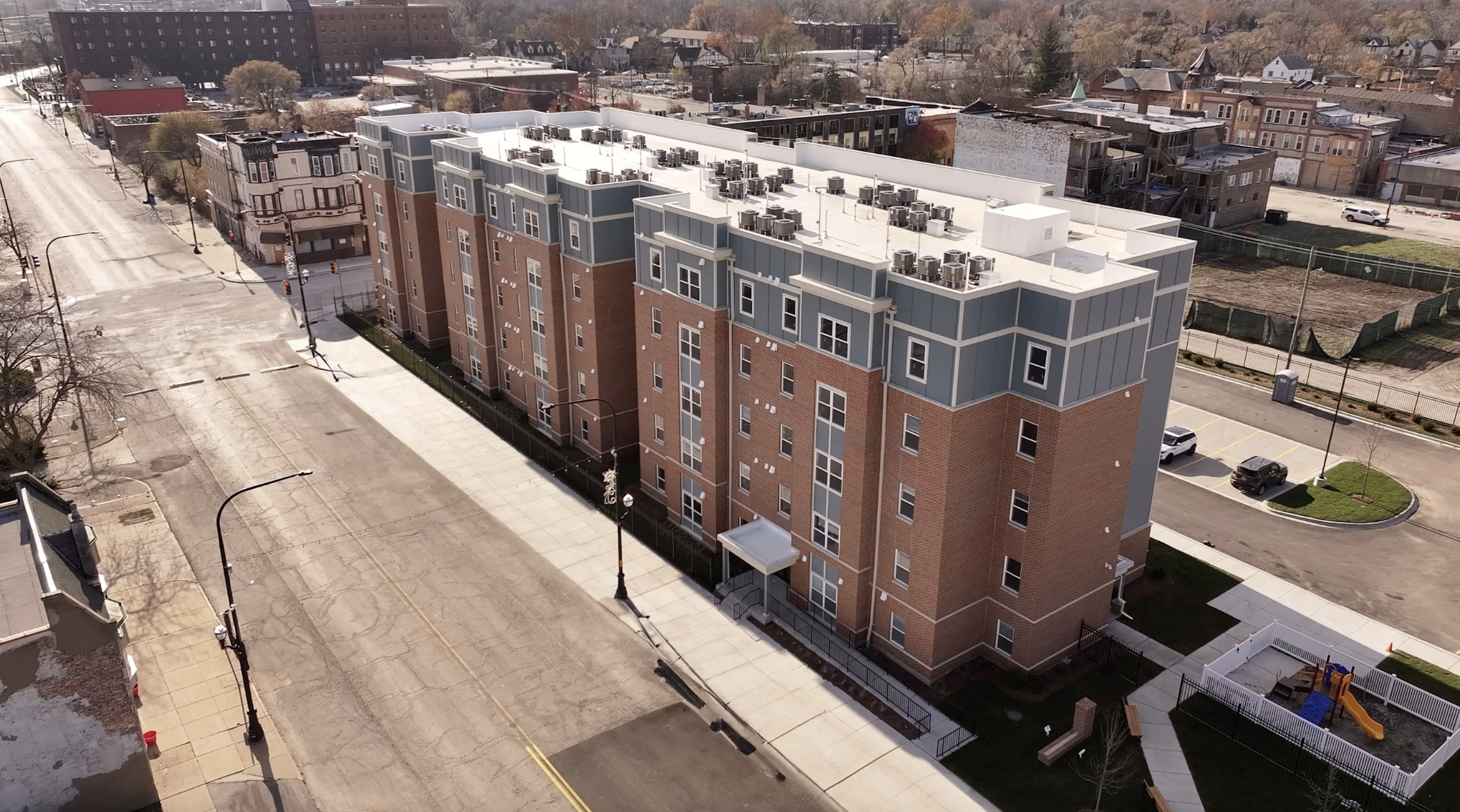
Photo courtesy of the Housing Authority of Cook County
The Development
Harvey Lofts is at the center of a planned effort by the City of Harvey to attract capital of all kinds to a reimagined downtown after years of disinvestment. As such, it closely aligns with the newly adopted Transit Oriented Development (TOD) Plan, which calls for more and better housing, investment in physical infrastructure, and other action items to make the downtown Harvey area more walkable, bikeable, safer, greener, and attractive to existing and future residents. Harvey Mayor Christopher Clark stated at the grand opening that “Harvey Lofts is more than a building — it’s a symbol of progress, resilience, and a brighter future for our city”.
Located roughly one block from Pace’s Harvey Transportation Center and the Metra Electric Harvey Station, which are set to be transformed into a unified, modern multimodal transportation center in 2026, and in the heart of what was once a bustling downtown, Harvey Lofts is the most significant development to date in Harvey’s new Transit-Oriented Development Tax Increment Financing (TIF) District.
Touted by many local leaders and residents as a watershed moment in the economic revitalization of the city of Harvey, Harvey Lofts is a 100% affordable, privately owned and operated, 5-story, 51-unit building with one, two, and three-bedroom apartments. First introduced to the Harvey Planning Commission in 2019, the development took time to work its way through the necessary channels before ultimately breaking ground in 2023; largely to-do with the COVID crisis of 2020.
The development was supported by a majority of the Harvey City Council, and support was shown by a large segment of the community. A key premise of supporters was that quality workforce housing in and of itself is an economic development tool that attracts talent to an area, which is an increasingly important consideration in the modern, high-tech economy.
Representing the largest private investment in the city of Harvey in decades, Pivotal Housing Partners’ (formerly MVAH) $19 million private investment could signal a new day for downtown Harvey. Further, the investment seems to have been well-informed, as thousands applied in the pre-application period, and the building opened in February 2025 to an entirely occupied building.
Goal
While the primary goal of Harvey Lofts is simply to provide quality workforce housing to residents of Harvey, the development also advances the related goal of attributing to the economic and social revitalization of Downtown Harvey.
Target
Renters with incomes up to 60% of the area median income (AMI).
Financing
Harvey Lofts was financed by an approximately $19 million private investment from Pivotal Housing Partners (formerly MVAH), which also leveraged a $12 million through the 9% Low-Income Housing Tax Credit Program, a Cook County permanent loan using federal Home Investment Partnerships Program funds, and American Rescue Plan Act funds contributed by The Illinois Housing Development Authority. The City of Harvey also contributed by ‘de-risking’ the construction, providing a low-cost parcel to the development and certain TIF increments, in accordance with performance benchmarks outlined in a redevelopment agreement.
Success
Thousands of applications were filed in the pre-leasing process, and the building has remained 100% occupied since its opening, a testament to the unmet demand for workforce housing in the South-Central subregion of suburban Cook County.
Lessons Learned
Harvey Lofts provides two important lessons for both the community and the region: First, such a significant private investment in downtown Harvey demonstrates that there is available capital for Chicago’s Southland when local partners point the way with good leadership, planning and collaboration – especially collaboration that helps manage the inevitable construction risks of a large-scale development. Second, the city used an open, transparent process with judicious use of incentives, and this helped overcome potential opposition to the development.
Contact Information
City of Harvey Planning and Zoning Division, www.cityofharveyil.gov
This case study was last updated in February 2026.
See More Case Studies
Home Grown is a collection of housing best practices implemented by local governments across the seven-county Chicago region. Each case study covers a housing policy, development, or program; how it works; why it was successful; and how it was funded. To see the full collection of case studies, click on the Home Grown logo.