
Fox Valley Apartments
Aurora
Kane County
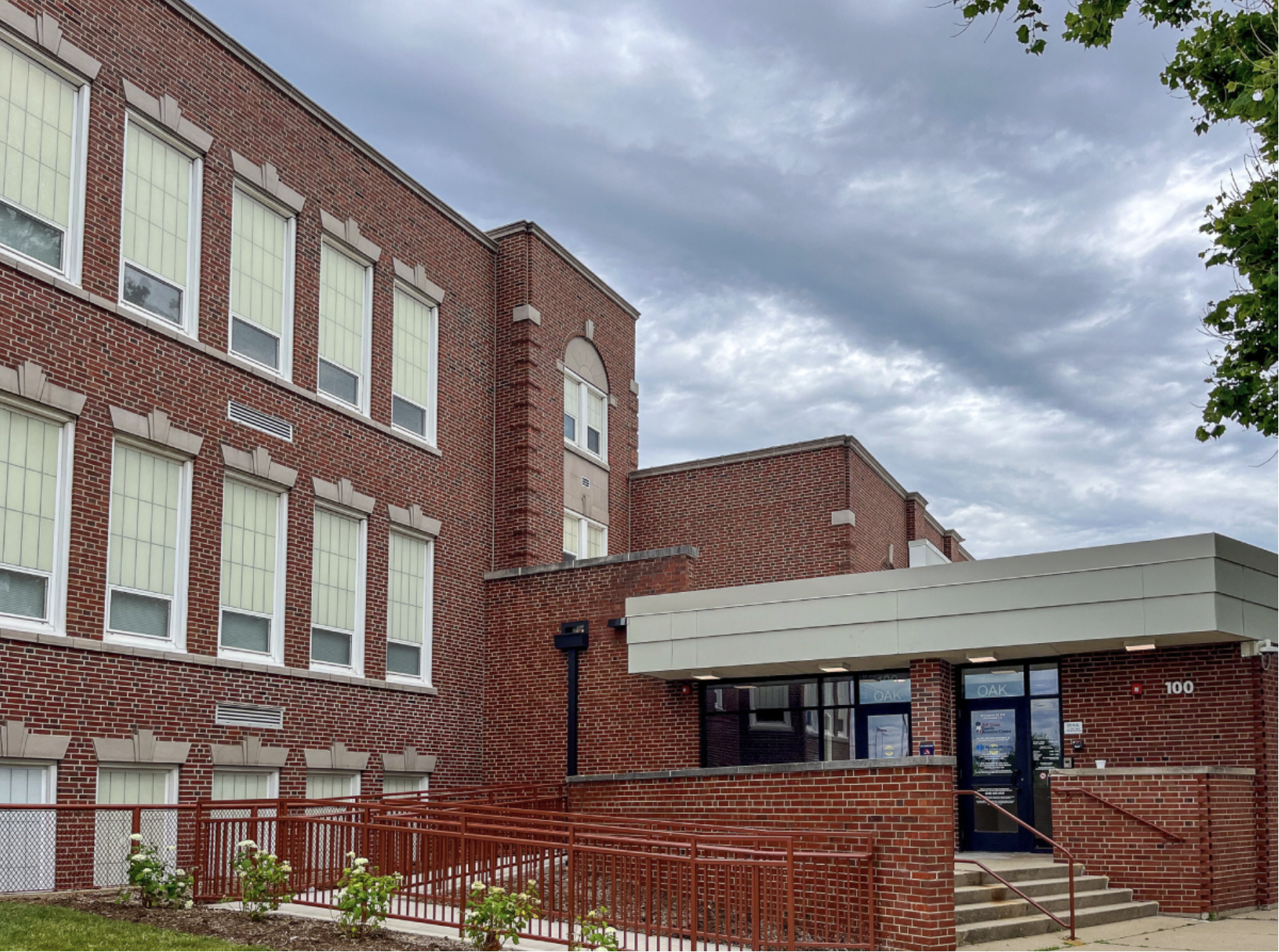
Photo courtesy of McShane Construction
The Development
After the Mary A. Todd School- a 1934 federal Works Progress Administration (WPA) project- ceased operations as an early childhood education center in 2019, West Aurora School District 129 then had in its possession two vacant school buildings; the other being the Abraham Lincoln School, vacant since 2009. Having learned from the longstanding vacancy of the Abraham Lincoln School, Aurora officials were wary of allowing the Mary A. Todd School to remain vacant for long and quickly began seeking adaptive re-uses of both buildings. West Aurora School District 129 then donated both school properties to the city of Aurora with the intention of either selling or donating the properties for their re-use.
Visionary Ventures– a nonprofit consortium of real estate professionals led by a board comprised entirely of Native Americans with the mission to create architecturally significant and environmentally sustainable workforce housing– was then sought out by the City to gauge their interest in developing the sites. Though Visionary Ventures was then a newly formed organization, its parent company, Housing 4 All (H4A), had extensive experience working with the City of Aurora, which led to the city approaching Visionary. Visionary Ventures was then able to begin financing and planning for the development knowing that city officials would lend their full support throughout the process. The community also supported the development, where several community members expressed appreciation for the development’s preservation of the schools, and still more expressed support for the development on the grounds of the great demand for affordable housing in the region. After receiving positive recommendations from three different review committees, the development and its several required zoning variations were unanimously passed by the City Council in October 2021. Not only did Aurora city council pass the proposed development, but they also agreed to provide significant financial support in the form of CDBG and HOME funds in addition to the donation of both properties. With McShane Construction Company acting as the general contractor, ground was broken in October 2022 and doors opened in March 2024.
Lincoln Elementary School, a 39,000 square foot building originally opened in 1893 as South Lake Street School and expanded and renamed in the 1920s, was remodeled into 14 modern apartments with fully equipped kitchens and large living spaces. On the parking lot of the Lincoln campus, a new, 28,000 square-foot building with 22 modern apartments was also constructed. Between both buildings, 1-, 2-, and 3-bedroom apartments are offered. Resident amenities also include two community rooms, a basketball court (the original school gym), a computer lab, a fitness center, a laundry room, and storage spaces. A mile down the road from the Lincoln School, the Mary A. Todd School, a 25,000 square-foot building constructed in 1934 on the site of the former Oak Street School where Mary A. Todd was once principal, was remodeled into 11 modern 1-, 2-, and 3-bedroom apartments. Additionally, as part of the deal for the transfer of properties, a health center for low-income students and families of West Aurora School District 129 was constructed on the ground floor.
As both the Lincoln School and the Todd School were of historic and architectural significance and contained several WPA works of art, and as the development was awarded historic preservation tax credits and thus subject to strict preservation guidelines, many of the original elements of the building were preserved and worked into the new design. As such, the buildings not only maintain their outside appearance, but also much of their interior; including the gymnasiums, chalkboards, built-in bookshelves, doors, flooring, and lockers. Additionally, both schools held several murals and statues that were created as a part of the WPA artists’ program, and as they were part of a federal program, are required to be displayed in a public setting. As such, the statues and murals were carefully removed from the building and displayed throughout the City, which is still in the process of restoration and site selection. The murals that were removed from inside the buildings were replaced with framed prints of the originals, maintaining the interior’s original splendor.
Goal
To return to productive use and bring back into the tax rolls two publicly owned, vacant schools with historic and architectural significance by transforming them into quality affordable housing for Aurora families.
Target
Households earning up to 60% of the Area Median Income (AMI). Of 47 total apartments created, 15 are reserved for households earning up to 30% AMI, and 32 are reserved for households earning up to 60% AMI.
Financing
A $22.8 million development, Fox Valley Apartments was financed with 9% LIHTC equity, a state donation tax credit, $2.9 million in Aurora HOME funds, $600k in Aurora CDBG funds, federal and state historic preservation tax credits, Rivers Edge Historic Preservation tax credits, and a permanent mortgage.
Success
By transforming two city-owned vacant school buildings into beautiful, affordable apartments, the city of Aurora and Visionary Ventures not only helped to fill the immense demand for affordable family housing, but also returned two defunct city-owned properties to the tax rolls; all while preserving the area’s historic and architectural character.
Lessons Learned
Municipal support and leadership in the development of affordable housing is crucial in attracting developers of such housing to a community. As developing affordable housing is a highly complicated process to begin with, affordable housing developers do not want to engage with communities where municipal leadership is not supportive. Additionally, as various municipalities around Chicagoland deal with the challenges of fluctuating/declining public-school enrollment and are being forced to weigh the impacts of school closures, the adaptive re-use of vacant schools into affordable housing has been a popular strategy to both maintain the use of a public asset and address the large demand for affordable housing.
Contact Information
City of Aurora Development Services Department, www.aurora.il.us
This case study was last updated in Februrary 2026.
See More Case Studies

Home Grown is a collection of housing best practices implemented by local governments across the seven-county Chicago region. Each case study covers a housing policy, development, or program; how it works; why it was successful; and how it was funded. To see the full collection of case studies, click on the Home Grown logo.