
Cleland Place
Wilmette
Cook County
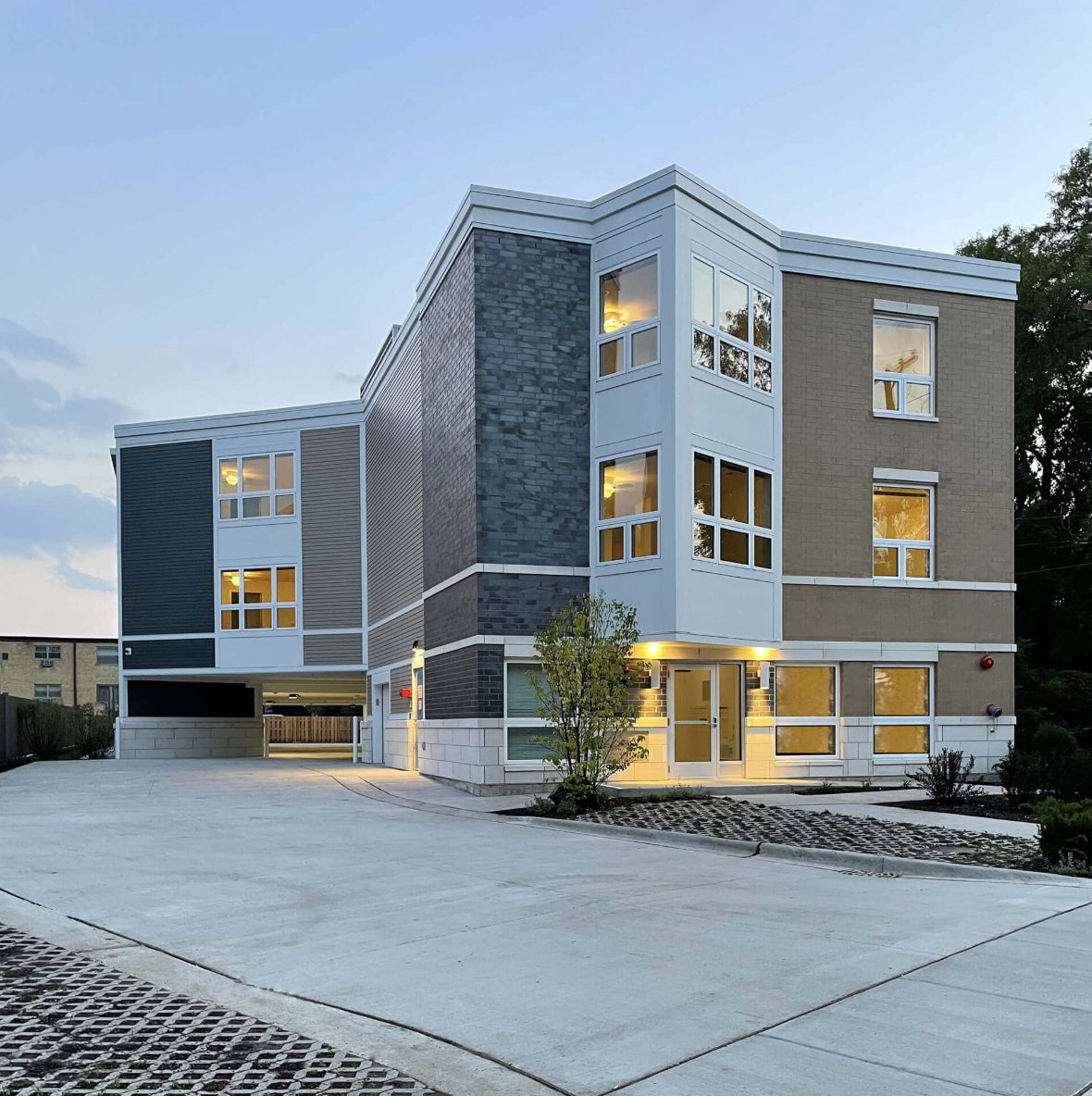
Photo courtesy of Housing Opportunity Development Corporation
The Development
In 2014, when Wilmette American Legion Post 46 listed their headquarters for sale in preparation of the Post’s closure, Housing Opportunity Development Corporation (HODC) identified the property as having potential for the development of affordable housing and purchased the building for $464,000. Of note, Post 46 members were proud to sell their headquarters to an affordable housing development corporation and maintained support for the later-proposed Cleland Place throughout the planning process. Shortly after the sale, HODC presented a proposal for Cleland Place to the Wilmette Planning Commission, resulting in the organization of significant community opposition to the development. Opposition even created a website dedicated to stopping the development, which argued that Cleland Place would increase traffic, impose an undue burden on the surrounding neighborhood, and threaten the safety of the community, among other things.
With less than 10% of its housing stock affordable, Wilmette had been far-short of the benchmark set by Illinois’ Affordable Housing Planning and Appeal Act (AHPAA) since the law’s inception in 2002. Working on a plan to reach that 10% threshold, Wilmette officials listened to the opposition but maintained throughout the process that affordable housing is an issue that they would prioritize. After several refinements to the original proposal spanning roughly three years of public meetings with village officials and neighbors, Wilmette Village Trustees unanimously approved the Cleland Place proposal in April of 2018, ground was broken in 2019, and doors opened in August of 2021.
Though there was vocal opposition to the development throughout the process by some of the community, many Wilmette residents made their support for the development heard during the building’s opening when hundreds showed up with flowers in support of their new neighbors.
Named in honor of longtime Wilmette resident, HODC founding board member, and lifelong civil rights advocate Jean Cleland (1923-2013), Cleland Place is a three-story, 16-unit building with a mix of 10 one-bedroom/one-bathroom units, and six two-bedroom/two-bathroom units, all of which are reserved for households earning up to 60% AMI and four of which have Project Based Vouchers. Applications are accepted from all income-eligible households, and several apartments are reserved for veterans and persons with a disability. Building amenities include 20 covered parking spaces, a community room, laundry room, elevator, security system, and resident-driven activities. In a great location, residents are within a mile of several grocery stores, parks, shops, schools, and public transit options. Sixteen low-income households have called Cleland Place home since its opening in 2021, providing an otherwise unattainable opportunity to live in the great community of Wilmette and breaking a long-standing economic barrier.
Goal
To provide quality affordable housing to low-income households in the high-opportunity Village of Wilmette.
Target
Households earning up to 60% of the Area Median Income (AMI) who live or work in Wilmette, with three apartments reserved for people with disabilities.
Financing
Financing partners included the Illinois Housing Development Authority (IHDA), the National Equity Fund, Village Bank and Trust (Wintrust), ComEd, and the Housing Authority of Cook County.
Success
Following several years of diligent and patient cooperation between HODC, Wilmette’s elected officials, and the community, the Village Board unanimously passed Wilmette’s first ever planned affordable housing development for families in its 150-year history. Today, Cleland Place offers quality affordable homes for sixteen low-income households and remains the only non-senior subsidized housing in Wilmette.
Lessons Learned
The overwhelming demand for Cleland Place’s 16 units- with expressed interest reaching 7x capacity- highlights the critical need for affordable housing in Wilmette and other high-opportunity/high-barrier Chicagoland suburbs. Further, even in a town like Wilmette, where land prices and home-values are among the highest in the region, creative financing options are available to make affordable housing developments financially feasible.
Contact Information
Village of Wilmette Community Development Department, www.wilmette.gov
This case study was last updated in February 2026.
See More Case Studies
Home Grown is a collection of housing best practices implemented by local governments across the seven-county Chicago region. Each case study covers a housing policy, development, or program; how it works; why it was successful; and how it was funded. To see the full collection of case studies, click on the Home Grown logo.