
Access West Cook
Near-West Suburbs
Cook County
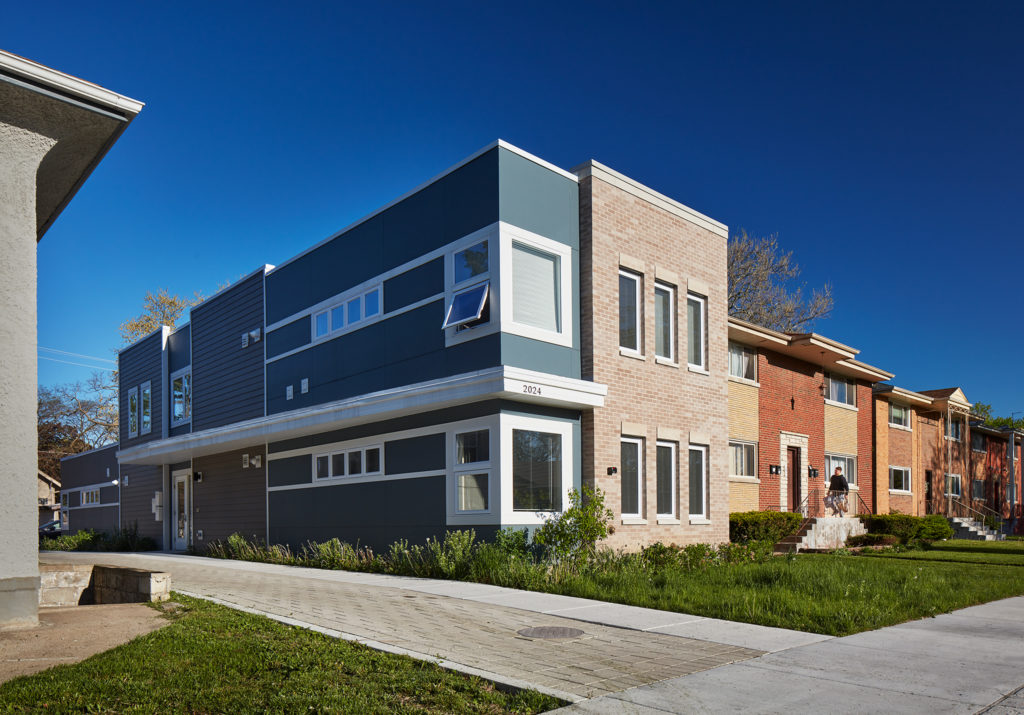
Photo courtesy of IFF
The Development
Developed through IFF’s Home First Initiative- a full-service housing development group creating new models of housing for people with disabilities- Access West Cook is an IFF-owned scattered-site housing development throughout Bellwood, Berwyn, Forest Park, and Maywood, four of the five towns originally part of the West Cook Housing Collaborative which selected IFF to be its development partner. Recognizing that West Cook County had the third highest foreclosure trends in Illinois, and that most of these towns were positioned to compete with each other for County and State dollars, IFF was selected on behalf of five municipal leaders to advance a joint strategy for prioritizing neighborhoods and sites for revitalization, and for securing funding for this work. Initially, with extensive support from regional and civic leaders, the sites selected were vacant and abandoned properties that were renovated for affordable homeownership.
To help finance this significant rental development, Access West Cook recognized the need for Project Based Vouchers (PBVs), long term operating subsidies, both to assist the future tenants and to provide the predictability needed to leverage permanent financing. At the time, the Regional Housing Initiative (RHI) was a collaborative vehicle of nine public housing authorities (PHAs), providing PBVs for families through a competitive process regionwide, to ensure a more equitable distribution of these limited and valuable resources.
Comprised of 16 formerly abandoned and foreclosed multifamily properties that were then either renovated or demolished and rebuilt, this development in total created 42 permanent affordable apartments, both 1- and 2-bedrooms, 33% of which are fully accessible and carefully tailored towards people with mobility impairments. WJW Architects provided accessible and enhanced design standards, frequently touted by disability and housing advocates for the multimodal approach — new construction, urban infill, renovation and reuse. Residents pay 30% of their income towards rent, and the Housing Authority of Cook County (HACC) subsidizes the remainder through its Project Based Voucher (PBV) program. Originally, this development received 25% of its PBVs through the Regional Housing Initiative (RHI) and was always intended to be administered by HACC. To be eligible for Access West Cook, the head of the household, co-head, or spouse must have a verifiable disability.
Goal
To create affordable and accessible housing for persons with a disability and their families in the Near-Western suburbs of Chicago, while advancing the West Cook Housing Collaborative’s revitalization priorities.
Target
All apartments are reserved for families earning up to 30% of the Area Median Income (AMI) and whose head of household has a disability.
Financing
The total development cost of $17 million was financed with a combination of tax credit equity through the 9% Low Income Housing Tax Credit (LIHTC) program, a grant from the Harry and Jeannette Weinberg Foundation, a HUD Sustainable Communities Challenge grant (advancing housing solutions near transportation), deferred developer fees, Federal Home Loan Bank funds, and an IFF Loan.
Success
This development was unusual in that its objectives were twofold. The central objective was to provide much needed affordable and accessible housing to a population that is historically underserved. The overarching strategy included building the capacity of municipalities highly burdened with vacant and abandoned properties, as a result of the foreclosure crisis, and focusing in on sites that would contribute to neighborhood revitalization priorities throughout West Cook.
Lessons Learned
Access West Cook was a complex development supported by two different collaborative efforts, the West Cook Housing Collaborative and the Regional Housing Initiative (RHI). Together, these efforts provided needed technical and financial support. Without either of these collaborative efforts, it would have been difficult for the individual towns to leverage, utilize, and benefit from these needed resources.
Contact Information
Illinois Facilities Fund: www.iff.org
This case study was last updated in February 2026.
See More Case Studies
Text describing the Housing Strategy Library.
People can click the logo to get back to the main page with all case studies.
